If you’ve ever listened in on air traffic control audio, you’ve probably noticed something strange: pilots and controllers don’t sound like they’re speaking ordinary English at all. Numbers come out clipped and oddly stressed, sentences run in a fixed order, and entire exchanges consist of phrases you’d never hear in daily conversation. That’s not an accent or a quirk — it’s a separate, standardized language layer called Aviation English, and it exists for one reason: safety.
Aviation English isn’t just English with jargon
General English is flexible. The same idea can be phrased a dozen ways, tone carries meaning, and ambiguity is usually harmless — a listener can ask “sorry, what do you mean?” without consequence. Radio communication between pilots and air traffic control has none of that margin. A transmission might be broken by static, clipped by a stuck microphone, or heard by a non-native speaker thousands of kilometers from home, and it has to be understood correctly the first time, every time.
To close that gap, the International Civil Aviation Organization (ICAO) built Aviation English around two pillars:
Standard phraseology. For routine situations — taxi instructions, altitude changes, frequency changes — ICAO defines a fixed set of phrases. There’s exactly one correct way to say “climb to flight level 350,” and pilots use it regardless of their native language. This removes the guesswork that comes with natural language variation.
Plain English, for everything else. Standard phraseology only covers predictable situations — roughly 70% of routine traffic. The moment something unusual happens — a diversion, a medical emergency, unexpected weather — controllers and pilots switch to plain English. This is why ICAO doesn’t just test phraseology memorization; it tests genuine English proficiency, because in an emergency, scripted phrases run out fast.
Word order and read-back discipline matter too. Instructions are read back verbatim by the receiving party — “climb and maintain five thousand, [callsign]” is repeated back exactly — so any mishearing gets caught and corrected before it becomes a problem. That closed-loop habit is arguably the single biggest structural difference between Aviation English and normal conversation.
The clearest example: numbers
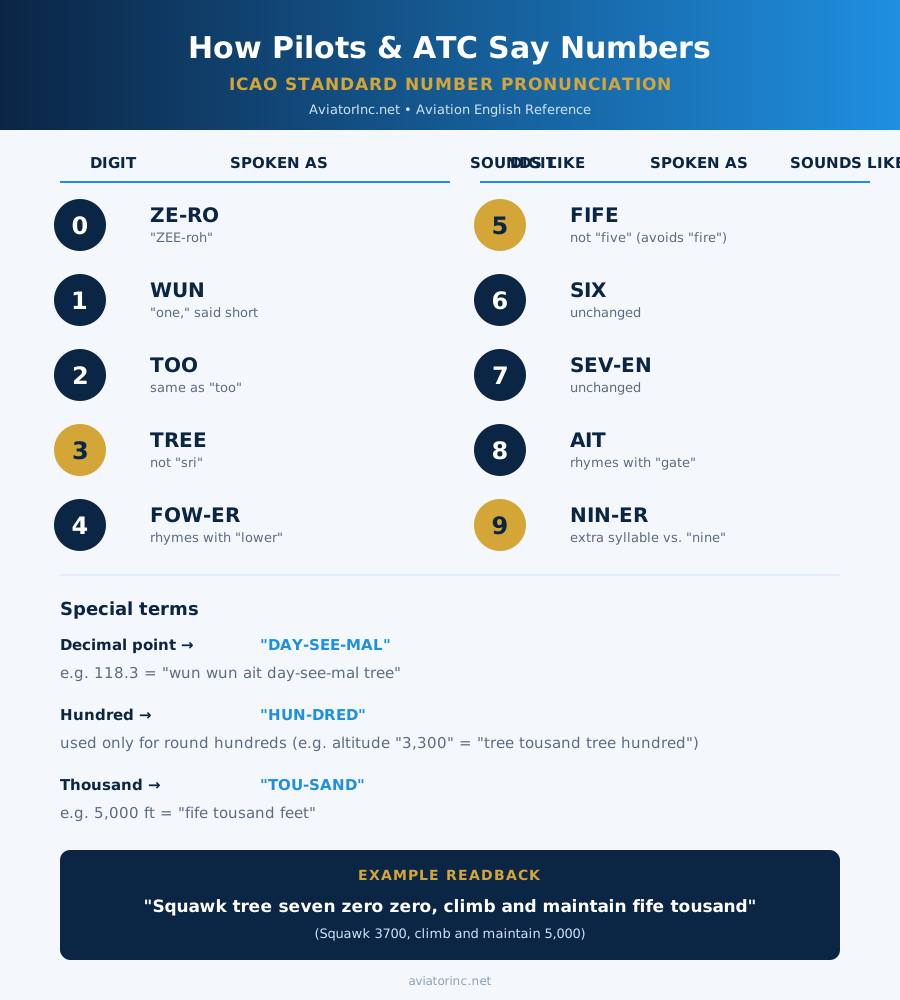
Nowhere is the difference more obvious — or more important — than in how numbers are spoken. Ordinary digit pronunciation is full of traps over a radio: “five” and “fire” can blur together through static, “nine” collides with the German word for “no” (nein), and “three” is easily clipped into something unintelligible. ICAO’s solution was to re-engineer the pronunciation of digits that cause the most confusion, while leaving the rest alone.
| Digit | Spoken as | Why it’s changed |
|---|---|---|
| 0 | ZE-RO | Full two syllables, never shortened to “oh” |
| 1 | WUN | Clipped and distinct |
| 2 | TOO | Unchanged from normal English |
| 3 | TREE | Avoids being misheard as “sri” |
| 4 | FOW-ER | Kept distinct from “for”/”fore” |
| 5 | FIFE | The “v” sound in “five” is too easily confused with “fire” |
| 6 | SIX | Unchanged |
| 7 | SEV-EN | Unchanged, but always both syllables |
| 8 | AIT | Unchanged sound, phonetic spelling only |
| 9 | NIN-ER | Extra syllable so it can’t be confused with German nein (“no”) |
Beyond single digits, there are fixed conventions for how numbers are grouped. Altitudes, headings, and squawk codes are read digit by digit rather than as whole numbers — “3,700” becomes “tree seven zero zero,” not “thirty-seven hundred.” Round hundreds and thousands are the exception: “5,000 feet” is read as “fife tousand feet,” and “3,300 feet” as “tree tousand tree hundred feet.” Decimal points, common in radio frequencies, get their own word — “day-see-mal” — so a frequency like 118.3 becomes “wun wun ait day-see-mal tree.” None of this is arbitrary; each convention exists because a real-world confusion was traced back to it.
How the ICAO English proficiency exam actually works
Every pilot and air traffic controller involved in international operations has to prove their English meets ICAO’s bar — and that’s measured through the ICAO English Language Proficiency Requirements (ELPR), tested on a six-point scale:
- Pre-elementary
- Elementary
- Pre-operational
- Operational — the minimum required to fly or control internationally
- Extended
- Expert
Only Levels 4, 5, and 6 are considered valid for operational duties. Level 4, “Operational,” is the practical floor: it means someone can communicate reliably not just in scripted phraseology, but in the unscripted plain English that emergencies demand.
The exam itself is entirely about listening and speaking — there’s no reading or writing component. It typically runs 25 to 40 minutes, delivered face-to-face with an examiner, via computer-based testing, or a mix of both. Candidates are scored across six separate criteria: pronunciation, structure, vocabulary, fluency, comprehension, and interactions. Crucially, there’s no averaging — a candidate must score at least Level 4 in every single one of the six categories. Being brilliant at vocabulary doesn’t compensate for weak pronunciation; each skill has to independently clear the bar.
The level someone achieves also determines how long the certification lasts before retesting is required:
- Level 4 (Operational): valid for 3 years under ICAO rules (some regional authorities, like EASA, extend this to 4)
- Level 5 (Extended): valid for 6 years
- Level 6 (Expert): valid for life — no retesting required
That renewal cycle is deliberate. Language proficiency, like any skill, can fade without regular use, so ICAO treats it the same way it treats a medical certificate or a type rating: something to be periodically re-verified, not proven once and assumed forever.
Why it’s worth learning properly
None of this is bureaucratic box-ticking. Aviation English exists because the space between “I understood most of that” and “I understood exactly that” is where accidents happen. Learning to say “tree” instead of “three,” or to read back every instruction word for word, isn’t about sounding like a movie pilot — it’s about building a communication system that survives static, accents, stress, and split-second decisions, every single time.
Leave a Reply