On July 24, 2026, Tivat Airport (TIV) ground to a halt. For over three hours — from 07:40 to 11:00 local time — no aircraft could land. Air Serbia, Air Montenegro, easyJet, Turkish Airlines, Eurowings, Israir, FlyOne and Norwegian Air Shuttle were all forced to divert to Podgorica, Tirana, Brindisi, Rome and Bari. Airport authorities cited an “unprecedented concentration of birds on the runway.”
It wasn’t a one-off. Bird-related incidents at Tivat have been climbing steadily: confirmed bird strikes rose from around 5 in 2023 to 17 in 2024, while total bird-related airspace events rose from 26 to 38 over the same period. Recent years have seen strikes on an EasyJet A320 (June 2024) and a SmartLynx A320 (2023), among others. The trend line points in one direction — and the causes are not mysterious.
A wetland the airport can’t touch
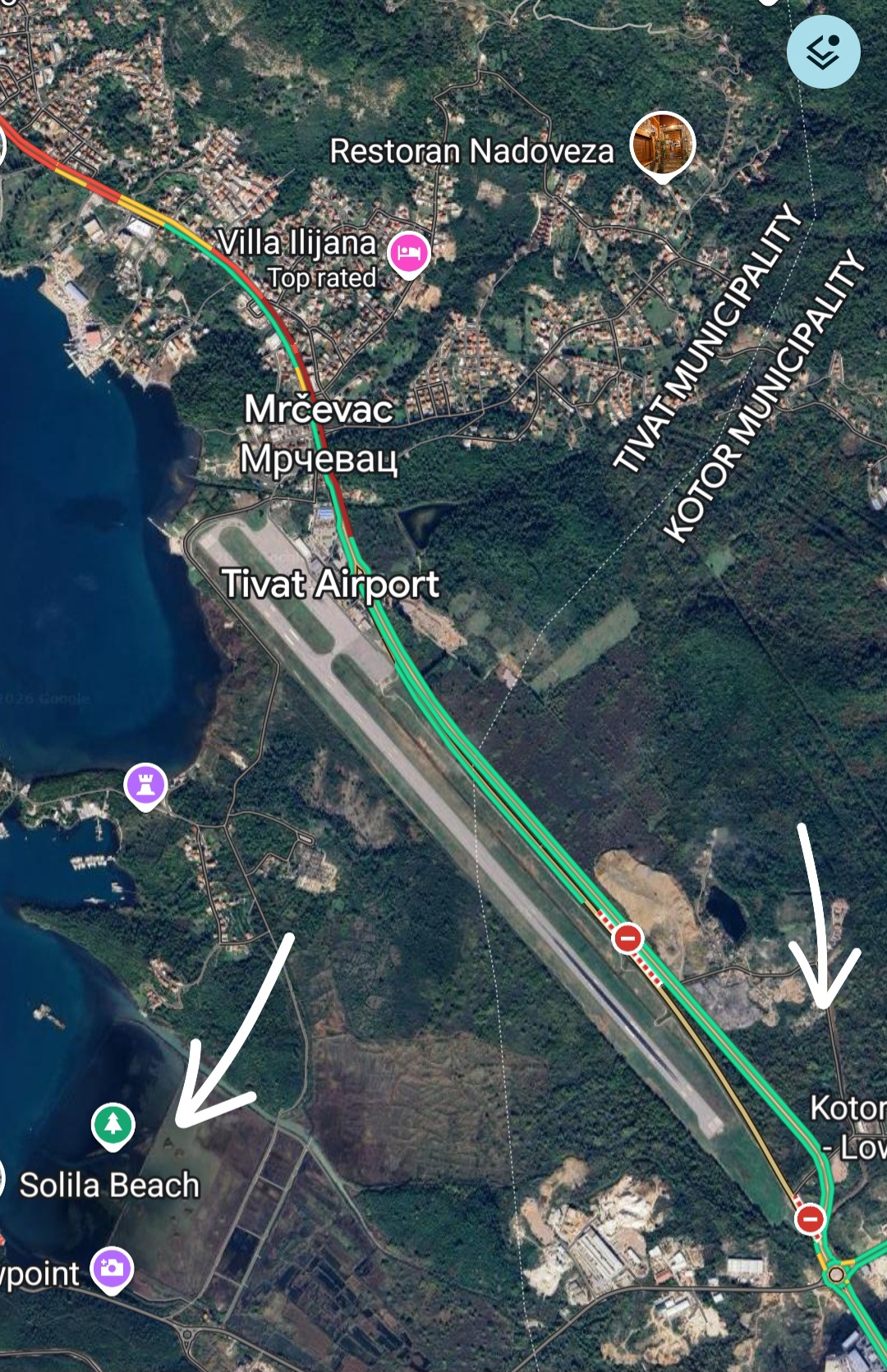
Tivat’s runway sits on reclaimed coastal land in the Grbalj valley, at the edge of the Bay of Kotor, with the runway threshold just 88 meters from the shoreline. Immediately adjacent is Solila, a roughly 150-hectare former salt-pan wetland that has been a protected nature reserve since 2007 and a Ramsar-listed Wetland of International Importance since 2013. It hosts more than 100 bird species — flamingos, herons, cormorants, egrets, birds of prey — and serves as a resting point on the Adriatic migratory flyway between Africa and northern/eastern Europe.
This is a structural, largely irreducible constraint. Solila is legally protected; the airport cannot disperse, drain, or disturb it the way it might a patch of unprotected scrubland. Coastal wetland and flight path were always going to overlap here.
An illegal landfill the airport absolutely can touch
The more troubling factor is different in kind. It has been identified as an illegal dump directly adjacent to the airport, on land owned by the company Montepranzo Bokaprodukt but used by the municipal utility Komunalno Tivat. Estimates put the volume at more than 5,000 cubic meters of waste, much of it organic — precisely the kind of food source that draws large, persistent gull and scavenger-bird flocks onto an active runway.
The site reportedly began under a temporary business agreement permitting limited transfer of waste pending a permanent municipal disposal location. That agreement has since lapsed, according to the landowner, yet dumping has continued. Montepranzo Bokaprodukt has formally notified the Tivat municipality, Montenegro’s Ministry of Ecology, Sustainable Development and Development of the North, the Ministry of Tourism and Transport, the Civil Aviation Agency, the Environmental Protection Agency, Airports of Montenegro, and environmental inspectors. Montenegro’s flight control agency has separately flagged the safety risk to the relevant authorities.
Unlike Solila, this is not a conservation trade-off — it’s a jurisdictional and enforcement gap between a private landowner, a municipal utility, and multiple state bodies, all of whom appear to have been warned before the July 24 shutdown.
Already on the official record
This isn’t a hazard that caught anyone by surprise on paper. Montenegro’s Aeronautical Information Publication (AIP), in the AD 2.LYTV aerodrome section, carries a standing caution:
“Maintain a careful look-out on APCH and DEP because of mountainous area close to AD. Birds in vicinity of AD.”
Jeppesen charts for LYTV carry the same warning in shorthand, printed directly on the airport diagram: “Birds in vicinity of apt.” This is a permanent aerodrome remark, not a one-off NOTAM — every crew flying into Tivat is briefed on it as a matter of course, and has been for years.
Two different problems, one runway
The result is that Tivat effectively has two bird-attractant systems stacked on top of each other at the exact moment traffic is at its seasonal peak — 2024 passenger numbers were up 32.5% year-on-year, and summer accounts for roughly 80% of annual volume. Airports of Montenegro says it applies radar-based detection and standard dispersal measures, but detection and dispersal can only do so much against a food source sitting a few hundred meters from the threshold.
Solila will remain a fixture of Tivat’s operating environment; that trade-off is the price of a genuinely scenic, biodiverse coastline. The landfill is the part of this story that has a straightforward fix — if the responsible authorities act on the warnings already on file.
Sources: Aviation Herald, Ground News, Investitor.me, Skala Radio, Portal Analitika, Grokipedia, Tivat Tourism Organisation, natureforpeople.org, Montenegro AIP (AD 2.LYTV), Jeppesen LYTV charts, public NOTAM records.
Leave a Reply