Tag: incident

  • Why Tivat Airport Has a Bird Problem — And Why It’s Getting Worse

    Why Tivat Airport Has a Bird Problem — And Why It’s Getting Worse

    On July 24, 2026, Tivat Airport (TIV) ground to a halt. For over three hours — from 07:40 to 11:00 local time — no aircraft could land. Air Serbia, Air Montenegro, easyJet, Turkish Airlines, Eurowings, Israir, FlyOne and Norwegian Air Shuttle were all forced to divert to Podgorica, Tirana, Brindisi, Rome and Bari. Airport authorities cited an “unprecedented concentration of birds on the runway.”

    It wasn’t a one-off. Bird-related incidents at Tivat have been climbing steadily: confirmed bird strikes rose from around 5 in 2023 to 17 in 2024, while total bird-related airspace events rose from 26 to 38 over the same period. Recent years have seen strikes on an EasyJet A320 (June 2024) and a SmartLynx A320 (2023), among others. The trend line points in one direction — and the causes are not mysterious.

    A wetland the airport can’t touch

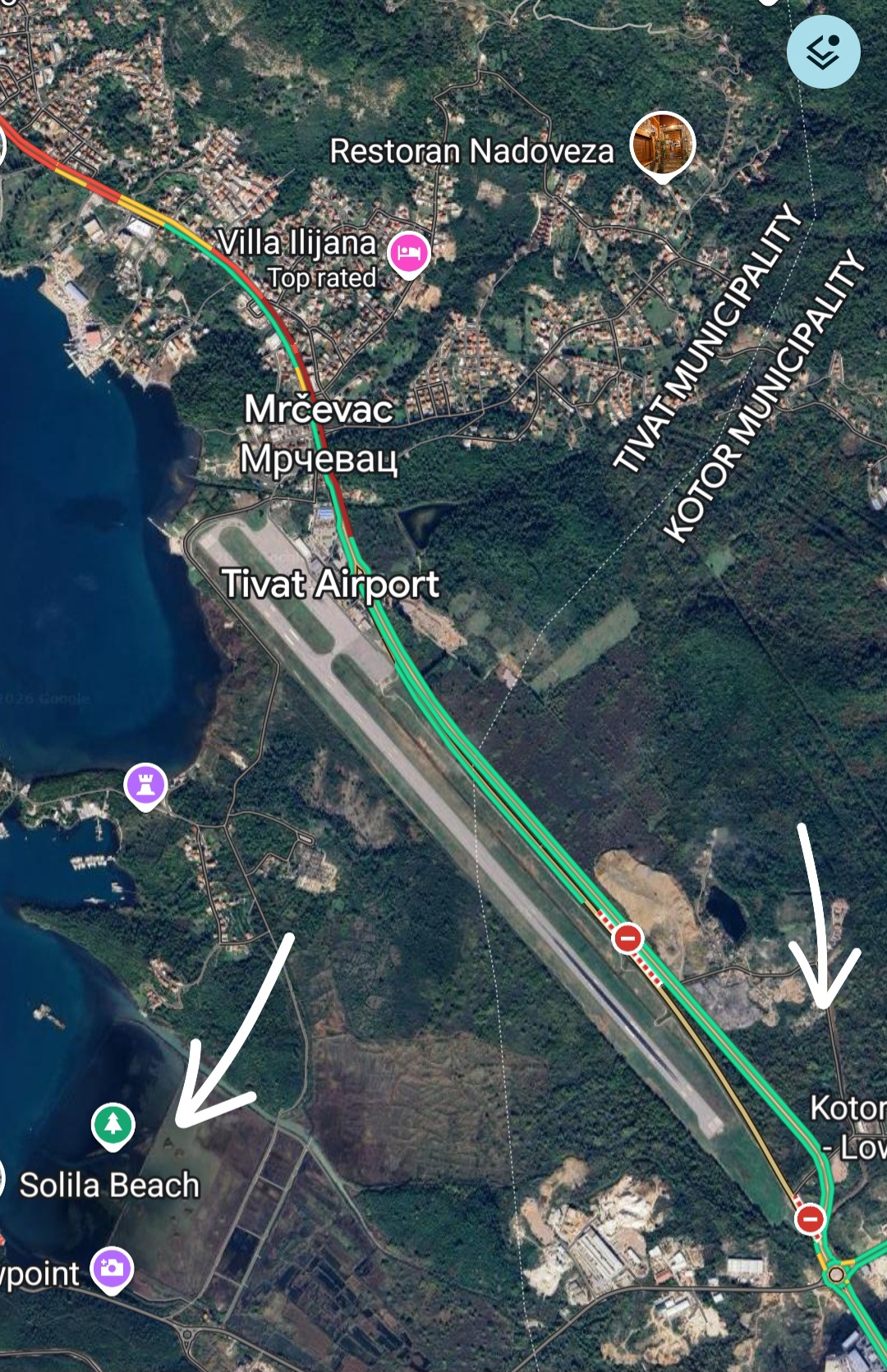
    Tivat’s runway sits on reclaimed coastal land in the Grbalj valley, at the edge of the Bay of Kotor, with the runway threshold just 88 meters from the shoreline. Immediately adjacent is Solila, a roughly 150-hectare former salt-pan wetland that has been a protected nature reserve since 2007 and a Ramsar-listed Wetland of International Importance since 2013. It hosts more than 100 bird species — flamingos, herons, cormorants, egrets, birds of prey — and serves as a resting point on the Adriatic migratory flyway between Africa and northern/eastern Europe.

    This is a structural, largely irreducible constraint. Solila is legally protected; the airport cannot disperse, drain, or disturb it the way it might a patch of unprotected scrubland. Coastal wetland and flight path were always going to overlap here.

    An illegal landfill the airport absolutely can touch

    The more troubling factor is different in kind. It has been identified as an illegal dump directly adjacent to the airport, on land owned by the company Montepranzo Bokaprodukt but used by the municipal utility Komunalno Tivat. Estimates put the volume at more than 5,000 cubic meters of waste, much of it organic — precisely the kind of food source that draws large, persistent gull and scavenger-bird flocks onto an active runway.

    The site reportedly began under a temporary business agreement permitting limited transfer of waste pending a permanent municipal disposal location. That agreement has since lapsed, according to the landowner, yet dumping has continued. Montepranzo Bokaprodukt has formally notified the Tivat municipality, Montenegro’s Ministry of Ecology, Sustainable Development and Development of the North, the Ministry of Tourism and Transport, the Civil Aviation Agency, the Environmental Protection Agency, Airports of Montenegro, and environmental inspectors. Montenegro’s flight control agency has separately flagged the safety risk to the relevant authorities.

    Unlike Solila, this is not a conservation trade-off — it’s a jurisdictional and enforcement gap between a private landowner, a municipal utility, and multiple state bodies, all of whom appear to have been warned before the July 24 shutdown.

    Already on the official record

    This isn’t a hazard that caught anyone by surprise on paper. Montenegro’s Aeronautical Information Publication (AIP), in the AD 2.LYTV aerodrome section, carries a standing caution:

    “Maintain a careful look-out on APCH and DEP because of mountainous area close to AD. Birds in vicinity of AD.”

    Jeppesen charts for LYTV carry the same warning in shorthand, printed directly on the airport diagram: “Birds in vicinity of apt.” This is a permanent aerodrome remark, not a one-off NOTAM — every crew flying into Tivat is briefed on it as a matter of course, and has been for years.

    Two different problems, one runway
    Map showing Tivat Airport with Solila to the southwest and the reported landfill site to the southeast
    Tivat Airport (TIV): Solila nature reserve sits southwest of the runway, by the coast; the reported waste site sits southeast, adjacent to the road toward Kotor — flanking the approach/departure path from both sides.

    The result is that Tivat effectively has two bird-attractant systems stacked on top of each other at the exact moment traffic is at its seasonal peak — 2024 passenger numbers were up 32.5% year-on-year, and summer accounts for roughly 80% of annual volume. Airports of Montenegro says it applies radar-based detection and standard dispersal measures, but detection and dispersal can only do so much against a food source sitting a few hundred meters from the threshold.

    Solila will remain a fixture of Tivat’s operating environment; that trade-off is the price of a genuinely scenic, biodiverse coastline. The landfill is the part of this story that has a straightforward fix — if the responsible authorities act on the warnings already on file.

    Sources: Aviation Herald, Ground News, Investitor.me, Skala Radio, Portal Analitika, Grokipedia, Tivat Tourism Organisation, natureforpeople.org, Montenegro AIP (AD 2.LYTV), Jeppesen LYTV charts, public NOTAM records.
  • What Really Happens When a Plane Loses a Window: Inside the Ryanair Decompression Scare

    What Really Happens When a Plane Loses a Window: Inside the Ryanair Decompression Scare

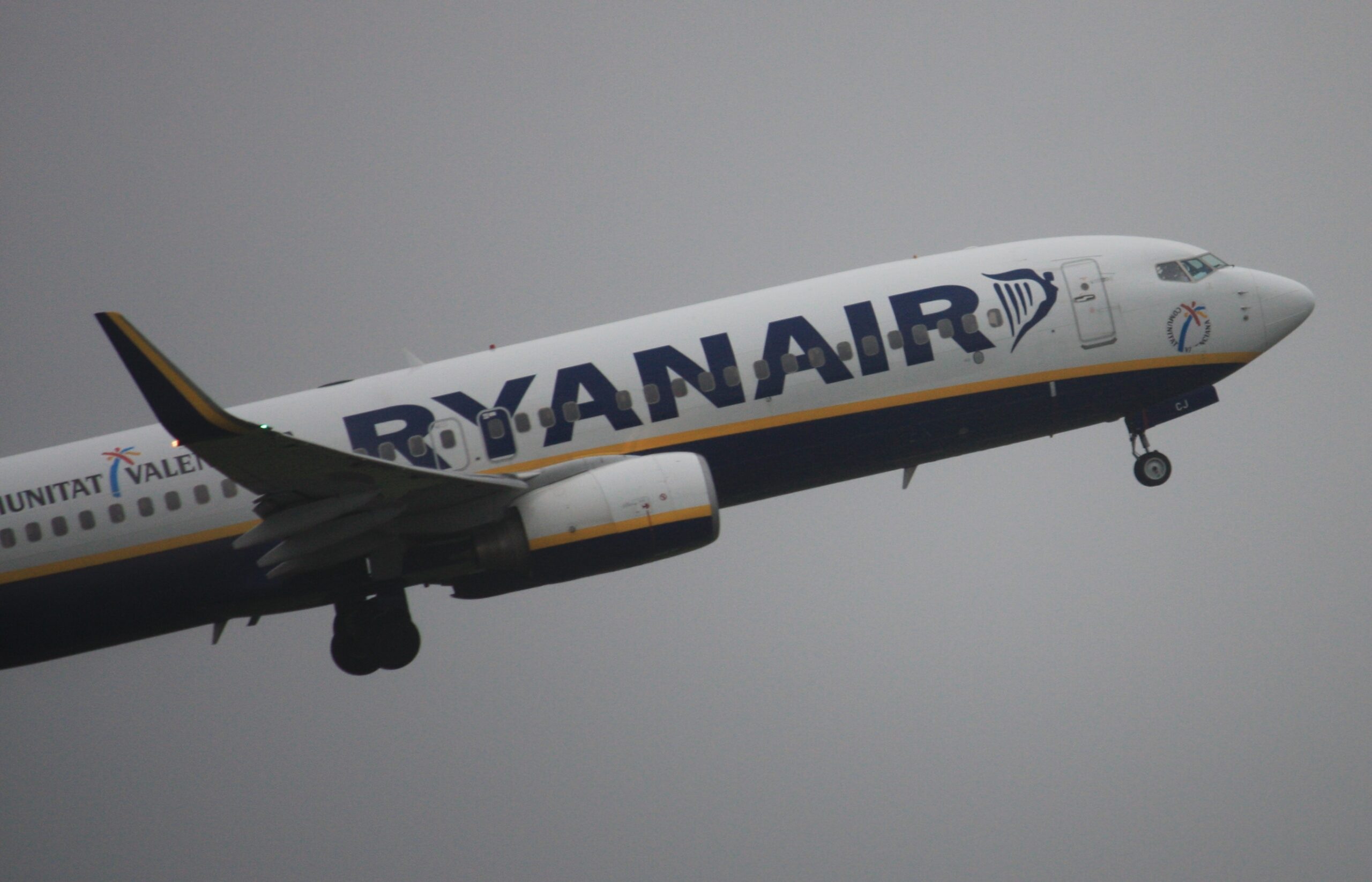
    A Ryanair Boeing 737-800
    Photo: Andrew Thomas from Shrewsbury, UK, via Wikimedia Commons, CC BY-SA 2.0 — EI-DCJ Boeing 737-8AS (cn 33564/1562) Ryanair, Birmingham Airport, June 2, 2012

    On Friday morning, a routine Ryanair departure from Thessaloniki to Memmingen, Germany, turned into a mid-air emergency that has reignited public fascination with one of aviation’s rarer and more frightening failure modes: sudden loss of cabin pressure.

    What happened aboard FR1879

    Flight FR1879 departed Thessaloniki at 6:12 a.m. local time on Friday, July 10, 2026. About eight to ten minutes into the climb, as the Boeing 737 operating for Ryanair (registered to sister carrier Malta Air) passed roughly 15,000–16,000 feet, it suffered an apparent engine problem. Debris — reportedly including a fan blade — struck the fuselage and shattered a cabin window. The sudden opening triggered an immediate pressure loss, and the passenger seated beside the window was pulled toward the gap, his head and shoulders briefly outside the aircraft.

    Passengers described a bang “like a tire bursting,” followed by screaming as oxygen masks dropped from the ceiling. Crucially, the man’s seatbelt was fastened, and it is widely credited — along with the grip of the person seated next to him — with keeping him from being pulled further out. The crew declared an emergency, flew a rapid descent, and returned the aircraft to Thessaloniki within minutes. One passenger was treated on the ground; everyone else continued their journey on a replacement aircraft.

    Greek and Irish aviation authorities, along with the US National Transportation Safety Board, are now investigating both the engine failure and the structural loss of the window.

    Explosive decompression: the physics in plain terms

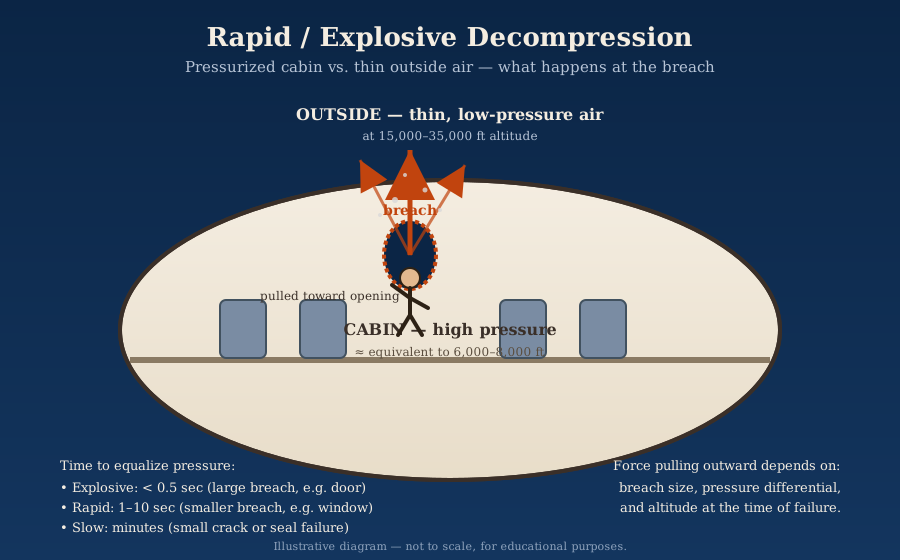
    Diagram of rapid and explosive cabin decompression

    Aviation engineers actually distinguish between several categories of pressure loss, and the distinction matters enormously for what a passenger experiences:

    • Explosive decompression happens in under half a second, typically from a large structural failure (a blown door or major fuselage breach). The pressure differential equalizes almost instantly, producing a violent outward rush of air, a fog of condensation, and genuine risk of objects — and unsecured people — being ejected.
    • Rapid decompression takes a few seconds, as with a smaller opening like a window. Still forceful, still deafening, but marginally less instantaneous.
    • Slow decompression, from a failed seal or small crack, can go unnoticed for minutes without an alarm.

    A critical detail in Friday’s incident: it occurred shortly after takeoff, not at cruising altitude. Cabin pressure differential builds progressively as an aircraft climbs toward cruise (typically 35,000–40,000 feet), where the pressure difference between the cabin and outside air is at its maximum. At a few thousand feet, the differential is far smaller — which is almost certainly why the outcome here was survivable without irreversible injury, whereas the same failure at cruise altitude could produce far more severe forces, hypoxia risk, and a shorter window for the crew to act.

    Standard operating procedure: what the crew is trained to do

    Airline crews drill decompression scenarios regularly, and the sequence is standardized across manufacturers:

    1. Don oxygen masks immediately — pilots first, since impaired judgment at altitude can happen within seconds without supplemental oxygen.
    2. Initiate an emergency descent, generally to 10,000 feet or the nearest safe altitude above terrain, as fast as the aircraft safely allows — often exceeding 3,000 feet per minute.
    3. Declare an emergency (squawk 7700) and coordinate immediately with air traffic control for priority routing and, if needed, diversion.
    4. Secure the cabin: cabin crew, once masks are confirmed, assess injuries, check for secondary hazards (loose debris, fire risk), and prepare for landing.
    5. Land at the nearest suitable airport — in this case, a return to the departure airport rather than continuing toward Germany.

    By all accounts, the FR1879 crew executed this playbook closely: masks deployed, a fast descent, a return to Thessaloniki within minutes of departure.

    How real is the “held onto him” scenario?

    This is where physics gets more encouraging than the footage suggests. Full ejection of an adult through a standard passenger window is aerodynamically difficult: airline windows are roughly the size of a dinner plate — far smaller than the width of a person’s shoulders — so the opening itself limits how much of a body can pass through, and the force pulling outward drops off sharply once shoulders wedge against the frame. That’s consistent with reporting here: the passenger went out head-and-shoulders first and no further, aided by his seatbelt.

    There is a well-known precedent that makes the “someone held on” detail entirely credible: British Airways Flight 5390 in 1990, when a cockpit windscreen blew out at altitude and the captain was sucked halfway out of the aircraft, torso outside the fuselage, for over twenty minutes. He survived because a flight attendant grabbed his legs and physically held on until the crew could land — a case still taught in aviation safety training today. Compared to that scenario, Friday’s incident involved a smaller opening, lower altitude, and a seatbelt already in place, all of which make a fellow passenger successfully holding on considerably more plausible, not less.

    What investigators will be looking for

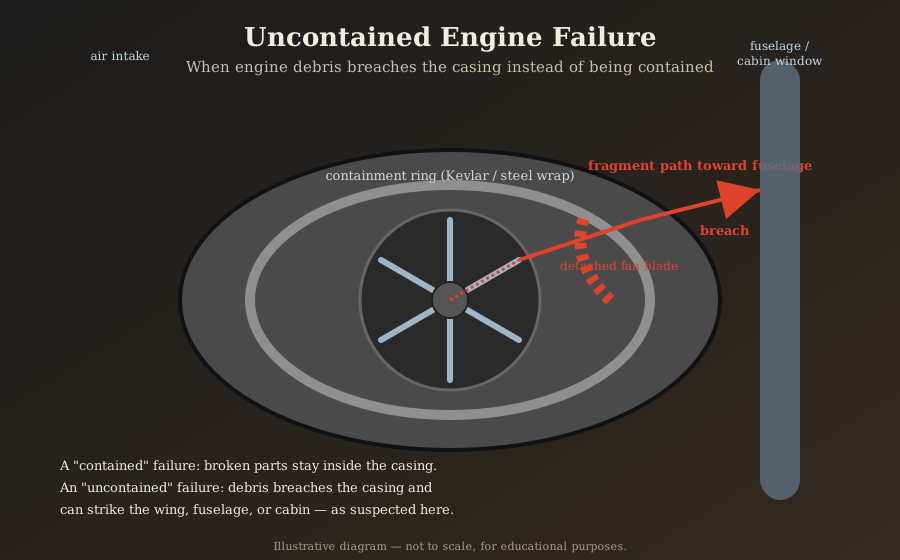
    Diagram of an uncontained engine failure

    Two separate threads will likely dominate the inquiry: why engine debris was able to depart the engine casing and strike the fuselage (a containment failure question, known in the industry as an uncontained engine failure), and why the window assembly failed as it did under that impact. Both feed into broader scrutiny of maintenance and manufacturing oversight that has followed Boeing 737 aircraft in recent years.

    For passengers, the practical takeaway hasn’t changed in decades: keep your seatbelt fastened whenever seated, even when the sign is off. In this incident, it may have made the difference between a terrifying scare and a fatality.


    This article is based on public reporting from CNN, Bloomberg, the Irish Times, and Greek broadcaster ERT, as investigations by Greek and international aviation authorities remain ongoing. Details may be updated as official findings are released.

  • Air Canada 737 MAX 8 Veers Off Runway Into Grass After Landing in Montreal

    Air Canada 737 MAX 8 Veers Off Runway Into Grass After Landing in Montreal

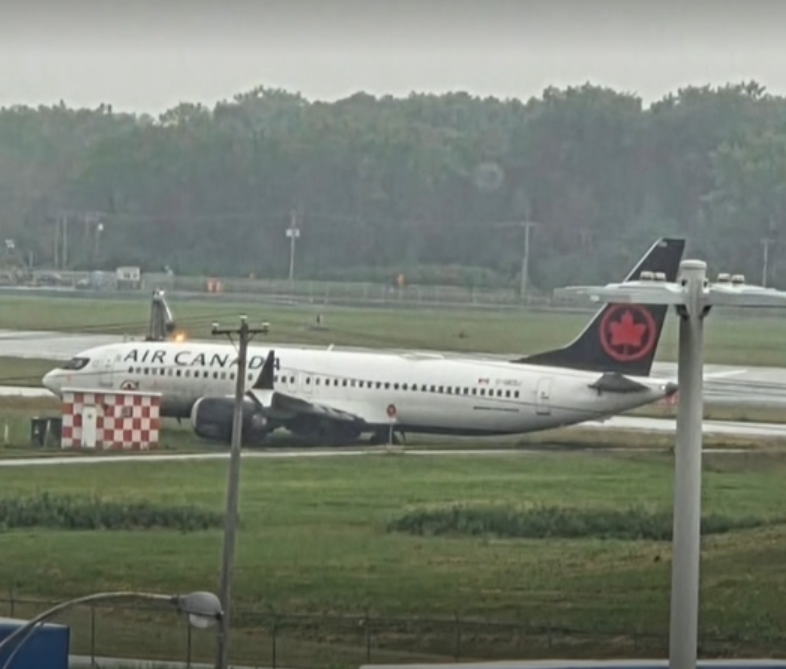
    An Air Canada Boeing 737 MAX 8 veered off the taxiway and came to a stop on the grass after landing at Montreal-Trudeau International Airport on Thursday, July 9. No injuries were reported among the 156 passengers and six crew on board.

    What Happened

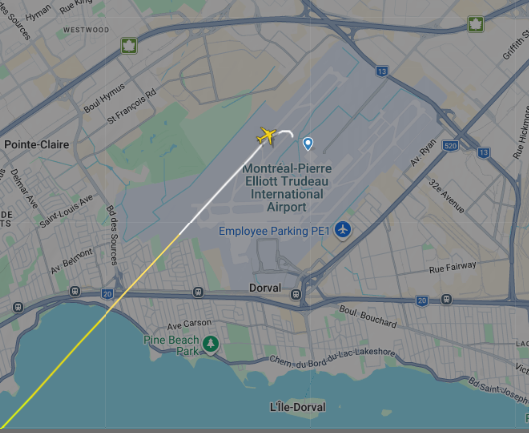
    Flight AC774, arriving from Los Angeles, landed on runway 06L at 3:57 p.m. — 41 minutes ahead of schedule — in rain and variable winds. According to ADS-B tracking data, the aircraft touched down normally and exited the runway via taxiway B3 at a ground speed of 55 knots, but failed to turn onto taxiway B and instead veered into the grass, where it came to rest.

    Flight tracking data showing AC774 on approach to Montreal-Trudeau Airport
    Flight tracking data showing AC774’s approach into Montreal-Trudeau.
    Air Canada Boeing 737 MAX 8 resting on the grass after exiting the runway at Montreal-Trudeau Airport

    Aircraft and Passengers

    The aircraft involved, registered C-GEOJ, was delivered to Air Canada in 2022. By 7:45 p.m., Air Canada confirmed that all passengers and crew had disembarked and been bused to the terminal. The 737 MAX 8 will be towed to a hangar for a full inspection.

    Airport Impact

    The runway was temporarily closed following the incident, causing delays of roughly 30 minutes for domestic and international flights, and 45 minutes to an hour for flights to the United States. The runway reopened just before 10 p.m. the same evening.

    What’s Next

    Air Canada has launched an investigation into the cause of the excursion and says it is working with the relevant authorities as the review continues.

    Sources: CBC News, Simple Flying, FlightGlobal