Category: Education

  • Bird Strike After Rotation: Examples, Procedures, Holding, Fuel, and Checklists

    Bird Strike After Rotation: Examples, Procedures, Holding, Fuel, and Checklists

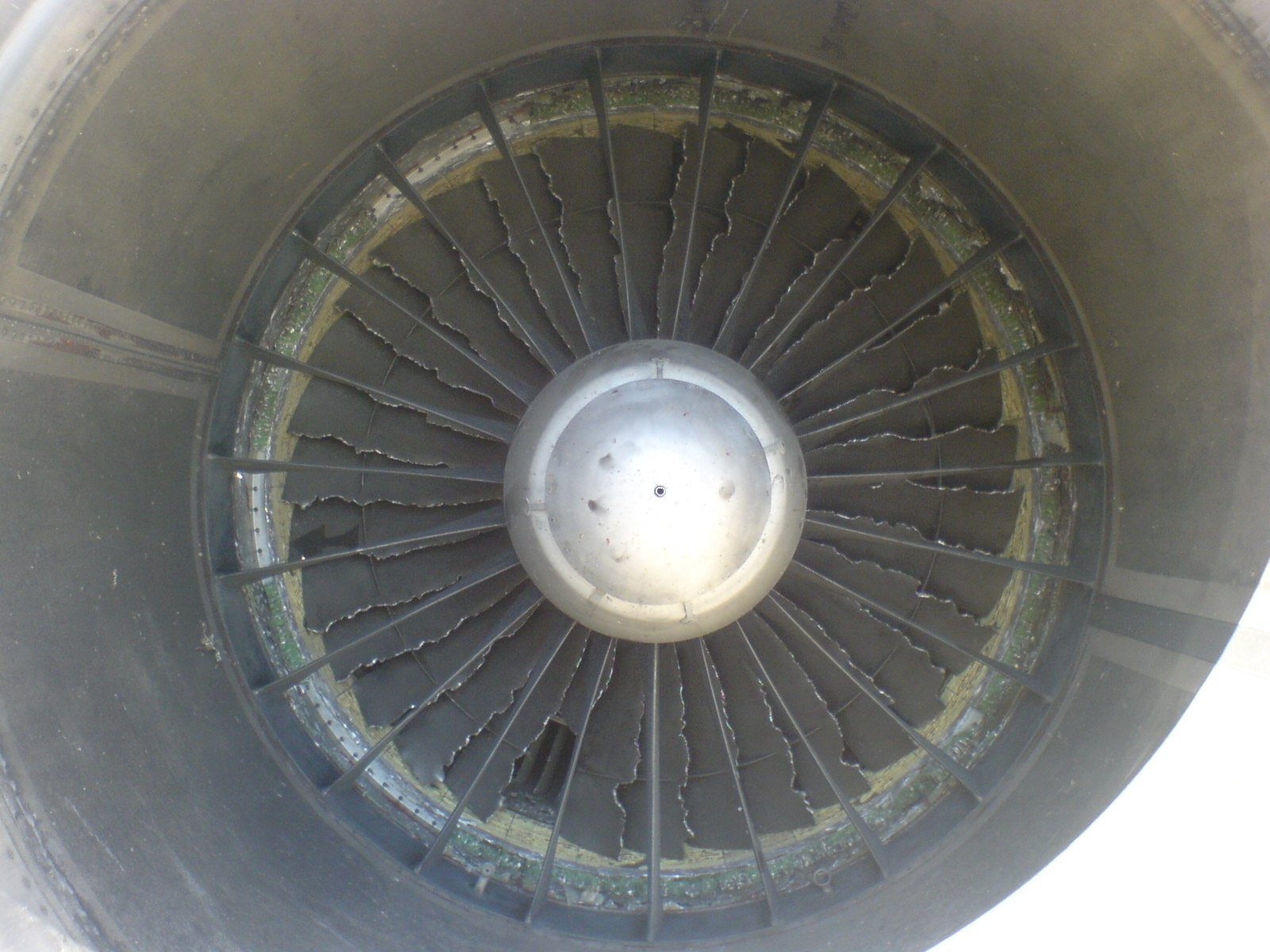
    Photo: Plenumchamber, licensed under CC BY-SA 3.0.

    There’s no worse moment for a bird to cross your flight path than the two or three seconds after rotation. You’re airborne but barely so — too fast and too committed to stop on the remaining runway, too low and too slow to have the full climb performance a jet is designed around. If the strike is a single bird, it’s usually a loud bang and a maintenance write-up. If it’s a flock, both engines can go quiet at once, and the crew has to fly a genuine emergency with almost no altitude to work with.
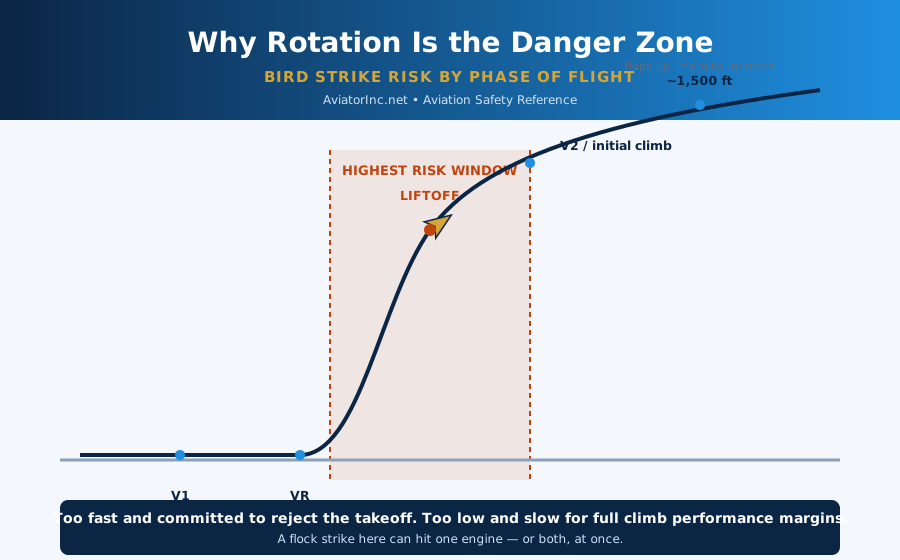
    Diagram showing why rotation and initial climb is the highest-risk phase for bird strikes

    Three times it happened for real

    Bird strikes at rotation aren’t a theoretical training scenario — they’ve shaped how airplanes are certified and how crews are trained, largely because of a handful of incidents that went very differently from each other.

    Eastern Air Lines Flight 375, a Lockheed Electra departing Boston in October 1960, flew into a 20,000-strong flock of starlings seconds after liftoff and lost control from asymmetric engine thrust. US Airways Flight 1549, an Airbus A320 departing LaGuardia in January 2009, lost both engines to a flock of Canada geese and ditched in the Hudson River. Ural Airlines Flight 178, an A321 departing Zhukovsky in August 2019, struck birds in both engines during rotation and came down gear-up in a cornfield.

    Comparison of three real bird strike incidents at or near rotation: Eastern 375, US Airways 1549, Ural Airlines 178

    What separates the 1960 Boston accident and the 2019 Moscow accident from the 2009 Hudson ditching isn’t luck alone. Sullenberger and Skiles had roughly three minutes and about 2,800 feet to work the problem before committing to a landing site — enough altitude to think. The Eastern and Ural crews had seconds and a few hundred feet. That’s the entire argument for why the procedures below exist: they’re designed to buy a crew the clearest possible picture of the aircraft before it runs out of altitude to use.

    A recent case close to home

    This isn’t just a historical pattern. On Friday, 17 July 2026, Air Serbia Flight JU130, an Airbus A320 (registration YU-APH) departing Belgrade Nikola Tesla Airport for Moscow, struck a bird shortly after takeoff, during the initial climb. The impact damaged the right engine. The crew declared “PAN PAN” — the standard urgency call, one step below a Mayday — and elected to return rather than continue toward Moscow. Public flight-tracking data shows the aircraft flying two holding patterns south of Belgrade — a larger one first, then a tighter one closer in — before lining up and landing back at Belgrade without incident. Nobody on board was hurt.
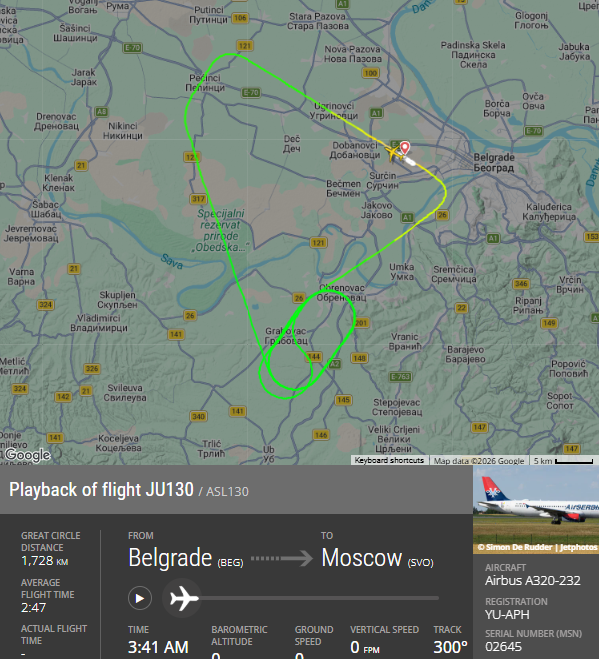
    FlightAware playback of Air Serbia JU130 showing the actual flight track with two holding patterns south of Belgrade before landing back at BEG
    Flight track via FlightAware (playback of JU130 / ASL130).

    It’s a textbook illustration of everything above, at a much smaller scale than Eastern 375, Ural 178, or the Hudson: a single engine affected rather than both, altitude and time enough to run the procedure properly, a deliberate return rather than a scramble, and an outcome that barely made the news because the system worked exactly as designed.

    The first ten seconds: fly the airplane, then diagnose

    The instinctive reaction to a bang, a flash, or a smell of burnt feathers is to look for what happened. That’s the wrong first move. The trained response is to hold pitch and airspeed and let the engine instruments — not assumption — say what’s actually going on. A strike on one engine is a very different problem from a strike on both, and at 300 feet you often can’t tell the difference by feel alone.

    If the indications are severe — an engine fire warning, or clear signs of a severe, uncontained failure — the response is a set of memory items: thrust lever to idle, the affected engine’s fuel/master switch off, fire agent discharged if called for. These are done from recall, before anyone opens a checklist, because there isn’t time to read. Anything short of that — vibration, an EGT spike, suspected damage without fire — is flown as a controlled single-engine (or reduced-thrust) climbout while the crew works the applicable non-normal procedure.

    On Airbus aircraft this is largely ECAM-driven: the system detects the failure and presents the checklist. Boeing crews lean more on recognizing the failure themselves and pulling the correct QRH procedure. Either way, once the memory items (if any) are complete, the rest is worked deliberately — item by item, not from memory, and not rushed.
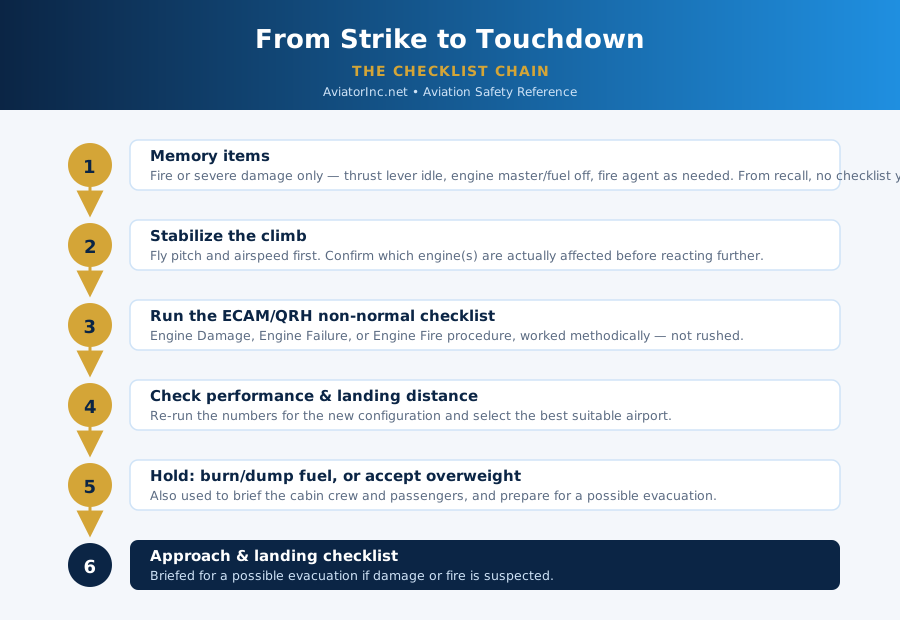
    Six-step checklist chain from bird strike memory items through approach and landing

    Why crews hold instead of turning straight back

    Once the aircraft is climbing safely and the checklist is under control, the instinct from the ground looking up is usually “just land, now.” In practice, crews will almost always request a hold near the departure airport instead of an immediate return. The hold isn’t hesitation — it’s exactly what separates a controlled outcome from a rushed one.

    That time is used to finish the non-normal checklist properly, brief the cabin crew on what happened and whether landing will require an evacuation, get passengers briefed and the cabin secured, recompute landing performance for the aircraft’s actual configuration, and coordinate the approach and any emergency services with ATC. It’s also, simply, time to think rather than react — the Ural 178 investigation is often cited precisely because the crew didn’t use the altitude they had to fully stabilize the aircraft’s energy state before landing.

    The other reason to hold: weight

    Most jets take off well above their maximum landing weight, since they burn down fuel over the course of a normal flight. Landing overweight increases stopping distance and structural loads on the gear and airframe, so if there’s no urgency — no fire, no fuel leak, damage that’s serious but controllable — the crew will hold and burn fuel down toward max landing weight, or, on aircraft fitted with a jettison system, dump fuel to get there faster.
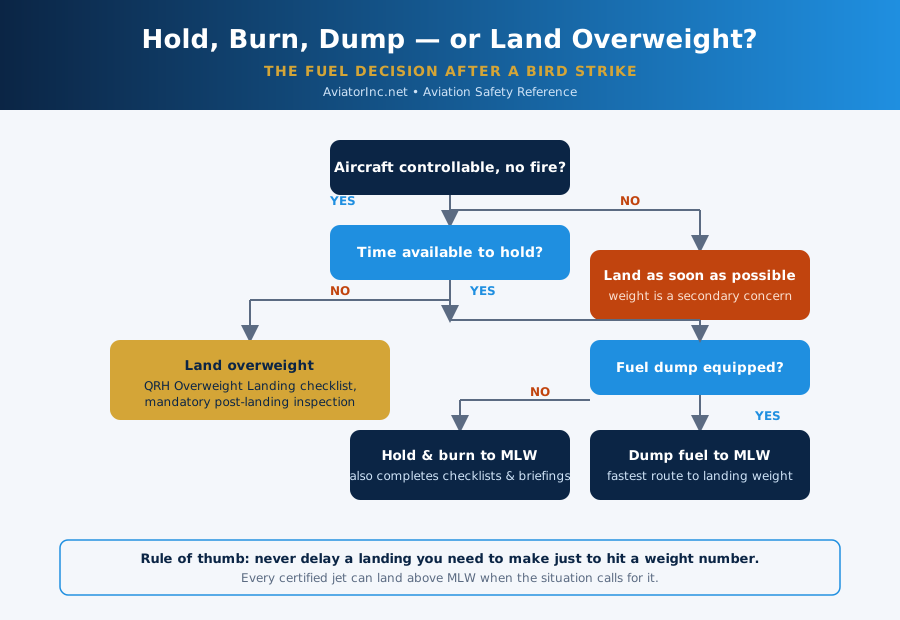
    Decision flowchart: hold and burn fuel, dump fuel, or land overweight after a bird strike

    But weight is never allowed to be the deciding factor in when to land. Every certified transport aircraft has an Overweight Landing procedure in the QRH for exactly this situation: it adjusts approach speed, sets the expectation of a firmer-than-normal touchdown, and requires a structural inspection once the aircraft is on the ground. If the situation is time-critical, crews are trained to use it without hesitation rather than extend a hold to chase a fuel number. The rule that gets taught: burn or dump fuel if you have time to spare, land overweight if you don’t — but never delay a landing you actually need to make.

    The takeaway

    None of this is about memorizing a script for its own sake. Every step — the memory items, the deliberate checklist pace, the hold, the weight decision — exists to give a crew the clearest possible picture of a damaged aircraft before altitude runs out. Eastern 375 didn’t have that time. US Airways 1549 did, and used every second of it. That’s the entire difference the procedure is designed to protect.
  • Aviation English: Why Pilots Don’t Talk Like Everyone Else

    Aviation English: Why Pilots Don’t Talk Like Everyone Else

    If you’ve ever listened in on air traffic control audio, you’ve probably noticed something strange: pilots and controllers don’t sound like they’re speaking ordinary English at all. Numbers come out clipped and oddly stressed, sentences run in a fixed order, and entire exchanges consist of phrases you’d never hear in daily conversation. That’s not an accent or a quirk — it’s a separate, standardized language layer called Aviation English, and it exists for one reason: safety.

    Aviation English isn’t just English with jargon

    General English is flexible. The same idea can be phrased a dozen ways, tone carries meaning, and ambiguity is usually harmless — a listener can ask “sorry, what do you mean?” without consequence. Radio communication between pilots and air traffic control has none of that margin. A transmission might be broken by static, clipped by a stuck microphone, or heard by a non-native speaker thousands of kilometers from home, and it has to be understood correctly the first time, every time.

    To close that gap, the International Civil Aviation Organization (ICAO) built Aviation English around two pillars:

    Standard phraseology. For routine situations — taxi instructions, altitude changes, frequency changes — ICAO defines a fixed set of phrases. There’s exactly one correct way to say “climb to flight level 350,” and pilots use it regardless of their native language. This removes the guesswork that comes with natural language variation.

    Plain English, for everything else. Standard phraseology only covers predictable situations — roughly 70% of routine traffic. The moment something unusual happens — a diversion, a medical emergency, unexpected weather — controllers and pilots switch to plain English. This is why ICAO doesn’t just test phraseology memorization; it tests genuine English proficiency, because in an emergency, scripted phrases run out fast.

    Word order and read-back discipline matter too. Instructions are read back verbatim by the receiving party — “climb and maintain five thousand, [callsign]” is repeated back exactly — so any mishearing gets caught and corrected before it becomes a problem. That closed-loop habit is arguably the single biggest structural difference between Aviation English and normal conversation.

    The clearest example: numbers

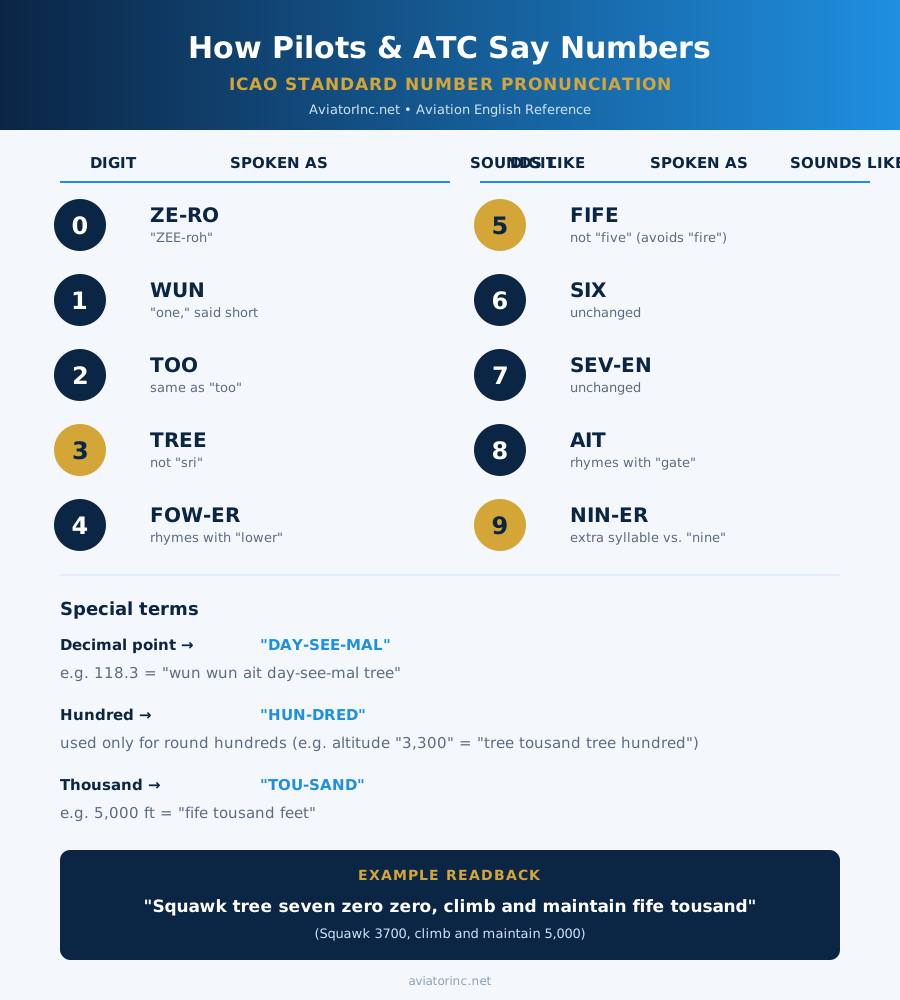
    Nowhere is the difference more obvious — or more important — than in how numbers are spoken. Ordinary digit pronunciation is full of traps over a radio: “five” and “fire” can blur together through static, “nine” collides with the German word for “no” (nein), and “three” is easily clipped into something unintelligible. ICAO’s solution was to re-engineer the pronunciation of digits that cause the most confusion, while leaving the rest alone.

    How pilots and ATC pronounce numbers — ICAO standard number pronunciation chart
    DigitSpoken asWhy it’s changed
    0ZE-ROFull two syllables, never shortened to “oh”
    1WUNClipped and distinct
    2TOOUnchanged from normal English
    3TREEAvoids being misheard as “sri”
    4FOW-ERKept distinct from “for”/”fore”
    5FIFEThe “v” sound in “five” is too easily confused with “fire”
    6SIXUnchanged
    7SEV-ENUnchanged, but always both syllables
    8AITUnchanged sound, phonetic spelling only
    9NIN-ERExtra syllable so it can’t be confused with German nein (“no”)

    Beyond single digits, there are fixed conventions for how numbers are grouped. Altitudes, headings, and squawk codes are read digit by digit rather than as whole numbers — “3,700” becomes “tree seven zero zero,” not “thirty-seven hundred.” Round hundreds and thousands are the exception: “5,000 feet” is read as “fife tousand feet,” and “3,300 feet” as “tree tousand tree hundred feet.” Decimal points, common in radio frequencies, get their own word — “day-see-mal” — so a frequency like 118.3 becomes “wun wun ait day-see-mal tree.” None of this is arbitrary; each convention exists because a real-world confusion was traced back to it.

    How the ICAO English proficiency exam actually works

    Every pilot and air traffic controller involved in international operations has to prove their English meets ICAO’s bar — and that’s measured through the ICAO English Language Proficiency Requirements (ELPR), tested on a six-point scale:

    1. Pre-elementary
    2. Elementary
    3. Pre-operational
    4. Operational — the minimum required to fly or control internationally
    5. Extended
    6. Expert

    Only Levels 4, 5, and 6 are considered valid for operational duties. Level 4, “Operational,” is the practical floor: it means someone can communicate reliably not just in scripted phraseology, but in the unscripted plain English that emergencies demand.

    The exam itself is entirely about listening and speaking — there’s no reading or writing component. It typically runs 25 to 40 minutes, delivered face-to-face with an examiner, via computer-based testing, or a mix of both. Candidates are scored across six separate criteria: pronunciation, structure, vocabulary, fluency, comprehension, and interactions. Crucially, there’s no averaging — a candidate must score at least Level 4 in every single one of the six categories. Being brilliant at vocabulary doesn’t compensate for weak pronunciation; each skill has to independently clear the bar.

    The level someone achieves also determines how long the certification lasts before retesting is required:

    • Level 4 (Operational): valid for 3 years under ICAO rules (some regional authorities, like EASA, extend this to 4)
    • Level 5 (Extended): valid for 6 years
    • Level 6 (Expert): valid for life — no retesting required

    That renewal cycle is deliberate. Language proficiency, like any skill, can fade without regular use, so ICAO treats it the same way it treats a medical certificate or a type rating: something to be periodically re-verified, not proven once and assumed forever.

    Why it’s worth learning properly

    None of this is bureaucratic box-ticking. Aviation English exists because the space between “I understood most of that” and “I understood exactly that” is where accidents happen. Learning to say “tree” instead of “three,” or to read back every instruction word for word, isn’t about sounding like a movie pilot — it’s about building a communication system that survives static, accents, stress, and split-second decisions, every single time.

  • The End of Leaded Avgas: What Will Replace 100LL

    The End of Leaded Avgas: What Will Replace 100LL

    A general aviation piston aircraft, the type of aircraft affected by the 100LL-to-unleaded avgas transition

    For nearly a century, piston-engine aircraft have run on leaded fuel. That era is now closing. Driven by an EPA finding that lead emissions from aviation gasoline endanger public health, the FAA and industry have committed to eliminating leaded avgas for U.S. piston aircraft by the end of 2030 (2032 in Alaska). Three unleaded fuels are now racing toward that deadline, each taking a different path to market.

    Why 100LL Has to Go

    100LL (“low lead”) is the last widely used leaded transportation fuel in the United States. Tetraethyl lead is added to prevent engine knock in high-compression piston engines, but it’s also a potent neurotoxin, especially harmful to children living near general aviation airports. In 2023 the EPA formally determined that lead emissions from piston aircraft endanger public health, triggering a legal requirement for the FAA to move the fleet to unleaded fuel. The public-private EAGLE initiative (Eliminate Aviation Gasoline Lead Emissions) was formed to coordinate that transition without grounding the roughly 170,000 piston aircraft that depend on 100-octane fuel.

    The Three Contenders

    GAMI G100UL. Developed by General Aviation Modifications Inc. over more than a decade, G100UL was the first fuel to receive a broad FAA-approved model list Supplemental Type Certificate, in September 2022, covering nearly all spark-ignition piston aircraft engines. GAMI markets it as a true drop-in replacement requiring no engine modifications, only placarding. It has matched or exceeded 100LL’s detonation protection in FAA-observed testing and began reaching airports in late 2024. Its main controversy: GAMI has declined to pursue an ASTM International production specification, the industry-standard process other fuel makers use, which has made some distributors and insurers cautious about handling it.

    Swift Fuels 100R. Swift took the opposite route, earning an ASTM production specification (D8603) for its 100-octane unleaded fuel. As of mid-2026, 100R has FAA certification via STC for more than 1,200 engine models, with airframe approvals continuing to expand, and it’s already sold commercially in the U.S. and parts of Europe. Swift also produces UL94, a lower-octane unleaded fuel that has been commercially available since 2016 but only suits engines that don’t need full 100-octane performance, around two-thirds of the piston fleet.

    LyondellBasell/VP Racing UL100E. This candidate is going through the FAA’s own Piston Aviation Fuels Initiative (PAFI) rather than the STC route, aiming for a fleet-wide authorization rather than aircraft-by-aircraft approval. It passed a critical 150-hour engine durability test and remains in FAA evaluation.

    What’s Actually in the Tank

    100LL is a blend of alkylate and other high-octane hydrocarbons (isooctane, toluene, xylene) with tetraethyl lead (TEL) added as the antiknock agent — currently capped at 2.12 grams of TEL per gallon, half the level of the older 100/130 grade it replaced. The unleaded contenders swap that lead out for different octane-boosting chemistry:

    FuelOctaneBase compositionAntiknock/octane boosterDensity (lb/gal)Production standard
    100LL100/130Alkylate + aromatic hydrocarbons (toluene, xylene)Tetraethyl lead, 2.12 g/gal~6.0ASTM D910
    G100UL100High-octane alkylate baseAromatic amine (m-toluidine, ~3–4.5%) + trimethylbenzene~6.2–6.3GAMI proprietary spec (no ASTM)
    Swift 100R100Alkylate baseRenewable oxygenatesNot yet publishedASTM D8603
    Swift UL9494Alkylate base, water-white (uncolored)Non-lead, non-aromatic-amine formulation5.9ASTM D7547
    LyondellBasell/VP UL100E100Alkylate baseProprietary (undisclosed)Under FAA testingPursuing FAA fleet authorization

    What’s Different About Flying on Unleaded

    A general aviation piston aircraft on the ramp

    Early operational experience has surfaced a few things pilots and mechanics are watching:

      The Road to 2030

      The FAA released a draft four-phase transition plan for public comment in January 2026: establishing and comparing approved fuels, letting the market gain experience, a national rollout, and finally the Alaska transition in 2032. California has already passed its own law banning the sale of leaded avgas from January 1, 2031, timed to fall one day after the federal deadline, and other states are watching closely.

      Cost remains a sticking point. Unleaded fuels have generally sold at a premium over 100LL, sometimes $1–2 more per gallon, and airports need separate, dedicated fuel systems if they stock more than one grade at once. Supporters argue the price gap will close as production scales and that lower maintenance costs offset it; critics, including some pilot groups, argue the economics still favor sticking with 100LL as long as it’s legally available.

      Either way, the direction is set. Within the next few years, most general aviation aircraft in the U.S. will be filling up with something other than the fuel that’s powered them for eighty years.

      So Which One Wins?

      On raw head start, G100UL is ahead. It has the broadest FAA approval of any unleaded 100-octane fuel, an AML-STC covering nearly the entire spark-ignition piston fleet, over a decade of development, and it’s already being pumped at a growing number of U.S. airports. If the race were decided purely on “which fuel can go into the most airplanes today,” GAMI’s product is the clear leader.

      But certification breadth isn’t the same as industry buy-in, and that’s where the picture gets more complicated. G100UL’s refusal to pursue an ASTM International production specification has left it outside the standard that every other current aviation fuel, including 100LL itself, is built on. That’s fed real hesitation from airframe makers (Cirrus has declined to approve it over sealant concerns), from insurers, and from Swift Fuels, which won’t allow G100UL to be commingled with its own products. Reports of paint staining, fuel leaks, and elastomer damage since G100UL reached the field in late 2024 have also given distributors and FBOs reason to move cautiously.

      Swift Fuels’ 100R is the strongest challenger, and arguably the safer long-term bet. It’s the only 100-octane unleaded fuel with an ASTM production specification (D8603), the process the broader industry, OEMs, and regulators are accustomed to trusting. Its STC coverage is expanding fast (over 1,200 engine models by mid-2026, with airframe approvals following) and it’s already selling commercially in the U.S. and parts of Europe. Its lower-octane sibling, UL94, also has years of real-world dispensing history behind it, giving Swift an operational track record G100UL doesn’t have.

      LyondellBasell/VP Racing’s UL100E is the dark horse. It’s pursuing the FAA’s own fleet-authorization path rather than the STC route, which would in theory make it available to every aircraft without per-tail paperwork, but it’s still working through PAFI testing and is the furthest from market of the three.

      The most likely outcome isn’t a single winner but a split market: G100UL keeps its lead where it’s already established and distribution is in place, Swift’s 100R gradually gains share as ASTM backing wins over airports and insurers, and UL94 continues to serve the roughly two-thirds of the fleet that doesn’t need full 100-octane fuel. If one fuel does emerge as the de facto national standard by the 2030 deadline, industry momentum currently favors Swift’s ASTM-backed approach over G100UL’s technically-superior-but-unstandardized one, though GAMI’s head start and existing infrastructure mean that’s far from settled.

      Last updated: July 2026

      Frequently Asked Questions

      Is 100LL banned yet?
      No. 100LL remains legal and widely available in the U.S. The FAA’s EAGLE initiative targets elimination by the end of 2030 (2032 in Alaska), and California’s state ban takes effect January 1, 2031. No blanket federal ban is in effect today.

      What is G100UL?
      G100UL is a 100-octane unleaded avgas developed by GAMI. It holds the broadest FAA Supplemental Type Certificate of any unleaded avgas, covering nearly all spark-ignition piston aircraft engines, but it has not been submitted to ASTM International for a production specification.

      Can I mix unleaded avgas with 100LL?
      It depends on the fuel. G100UL can be freely mixed with 100LL in any approved aircraft. Mixing G100UL or 100LL with UL94, however, is restricted to aircraft already approved to use UL94 — check your aircraft’s specific fuel approvals before mixing.

      Which unleaded avgas is best for my aircraft?
      It depends on your engine’s octane requirement and which STCs are approved for your airframe/engine combination. Aircraft needing full 100-octane fuel can look at G100UL or Swift’s 100R; aircraft that can run on 94-octane or lower have more options, including Swift’s UL94.

      When will unleaded avgas be available at my airport?
      Availability varies widely by region and depends on local FBO decisions. GAMI and Swift both publish airport rollout maps on their websites, and the FAA’s draft transition plan outlines a phased national rollout through 2030.

    • What Really Happens When a Plane Loses a Window: Inside the Ryanair Decompression Scare

      What Really Happens When a Plane Loses a Window: Inside the Ryanair Decompression Scare

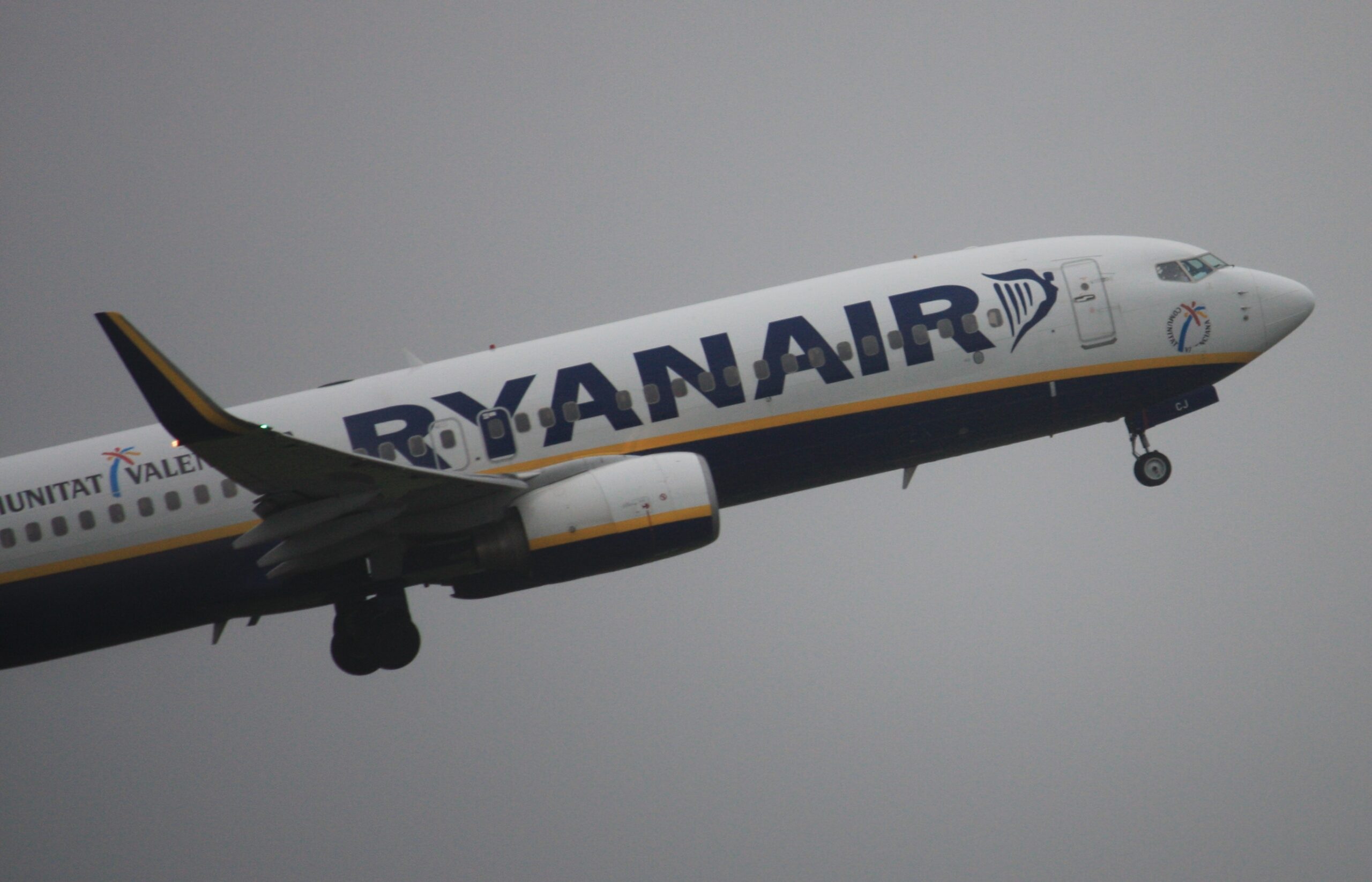
      A Ryanair Boeing 737-800
      Photo: Andrew Thomas from Shrewsbury, UK, via Wikimedia Commons, CC BY-SA 2.0 — EI-DCJ Boeing 737-8AS (cn 33564/1562) Ryanair, Birmingham Airport, June 2, 2012

      On Friday morning, a routine Ryanair departure from Thessaloniki to Memmingen, Germany, turned into a mid-air emergency that has reignited public fascination with one of aviation’s rarer and more frightening failure modes: sudden loss of cabin pressure.

      What happened aboard FR1879

      Flight FR1879 departed Thessaloniki at 6:12 a.m. local time on Friday, July 10, 2026. About eight to ten minutes into the climb, as the Boeing 737 operating for Ryanair (registered to sister carrier Malta Air) passed roughly 15,000–16,000 feet, it suffered an apparent engine problem. Debris — reportedly including a fan blade — struck the fuselage and shattered a cabin window. The sudden opening triggered an immediate pressure loss, and the passenger seated beside the window was pulled toward the gap, his head and shoulders briefly outside the aircraft.

      Passengers described a bang “like a tire bursting,” followed by screaming as oxygen masks dropped from the ceiling. Crucially, the man’s seatbelt was fastened, and it is widely credited — along with the grip of the person seated next to him — with keeping him from being pulled further out. The crew declared an emergency, flew a rapid descent, and returned the aircraft to Thessaloniki within minutes. One passenger was treated on the ground; everyone else continued their journey on a replacement aircraft.

      Greek and Irish aviation authorities, along with the US National Transportation Safety Board, are now investigating both the engine failure and the structural loss of the window.

      Explosive decompression: the physics in plain terms

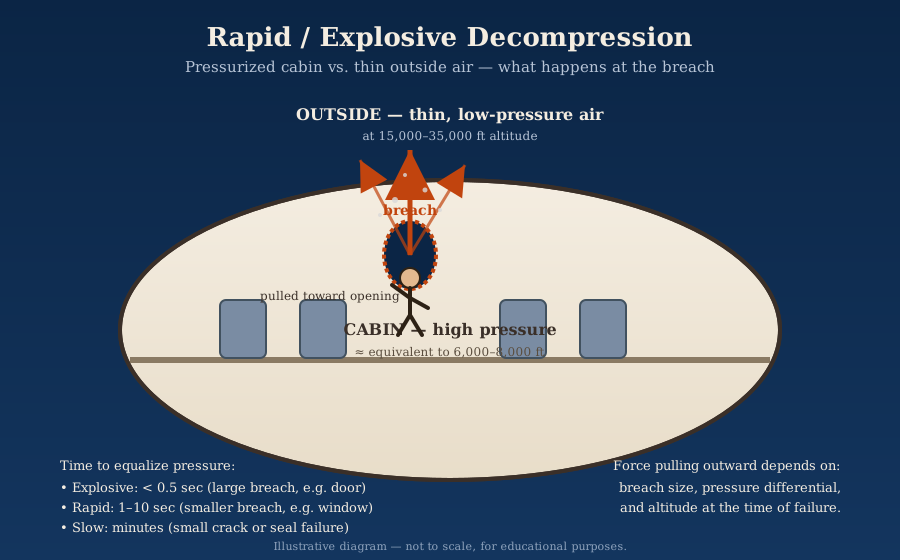
      Diagram of rapid and explosive cabin decompression

      Aviation engineers actually distinguish between several categories of pressure loss, and the distinction matters enormously for what a passenger experiences:

      • Explosive decompression happens in under half a second, typically from a large structural failure (a blown door or major fuselage breach). The pressure differential equalizes almost instantly, producing a violent outward rush of air, a fog of condensation, and genuine risk of objects — and unsecured people — being ejected.
      • Rapid decompression takes a few seconds, as with a smaller opening like a window. Still forceful, still deafening, but marginally less instantaneous.
      • Slow decompression, from a failed seal or small crack, can go unnoticed for minutes without an alarm.

      A critical detail in Friday’s incident: it occurred shortly after takeoff, not at cruising altitude. Cabin pressure differential builds progressively as an aircraft climbs toward cruise (typically 35,000–40,000 feet), where the pressure difference between the cabin and outside air is at its maximum. At a few thousand feet, the differential is far smaller — which is almost certainly why the outcome here was survivable without irreversible injury, whereas the same failure at cruise altitude could produce far more severe forces, hypoxia risk, and a shorter window for the crew to act.

      Standard operating procedure: what the crew is trained to do

      Airline crews drill decompression scenarios regularly, and the sequence is standardized across manufacturers:

      1. Don oxygen masks immediately — pilots first, since impaired judgment at altitude can happen within seconds without supplemental oxygen.
      2. Initiate an emergency descent, generally to 10,000 feet or the nearest safe altitude above terrain, as fast as the aircraft safely allows — often exceeding 3,000 feet per minute.
      3. Declare an emergency (squawk 7700) and coordinate immediately with air traffic control for priority routing and, if needed, diversion.
      4. Secure the cabin: cabin crew, once masks are confirmed, assess injuries, check for secondary hazards (loose debris, fire risk), and prepare for landing.
      5. Land at the nearest suitable airport — in this case, a return to the departure airport rather than continuing toward Germany.

      By all accounts, the FR1879 crew executed this playbook closely: masks deployed, a fast descent, a return to Thessaloniki within minutes of departure.

      How real is the “held onto him” scenario?

      This is where physics gets more encouraging than the footage suggests. Full ejection of an adult through a standard passenger window is aerodynamically difficult: airline windows are roughly the size of a dinner plate — far smaller than the width of a person’s shoulders — so the opening itself limits how much of a body can pass through, and the force pulling outward drops off sharply once shoulders wedge against the frame. That’s consistent with reporting here: the passenger went out head-and-shoulders first and no further, aided by his seatbelt.

      There is a well-known precedent that makes the “someone held on” detail entirely credible: British Airways Flight 5390 in 1990, when a cockpit windscreen blew out at altitude and the captain was sucked halfway out of the aircraft, torso outside the fuselage, for over twenty minutes. He survived because a flight attendant grabbed his legs and physically held on until the crew could land — a case still taught in aviation safety training today. Compared to that scenario, Friday’s incident involved a smaller opening, lower altitude, and a seatbelt already in place, all of which make a fellow passenger successfully holding on considerably more plausible, not less.

      What investigators will be looking for

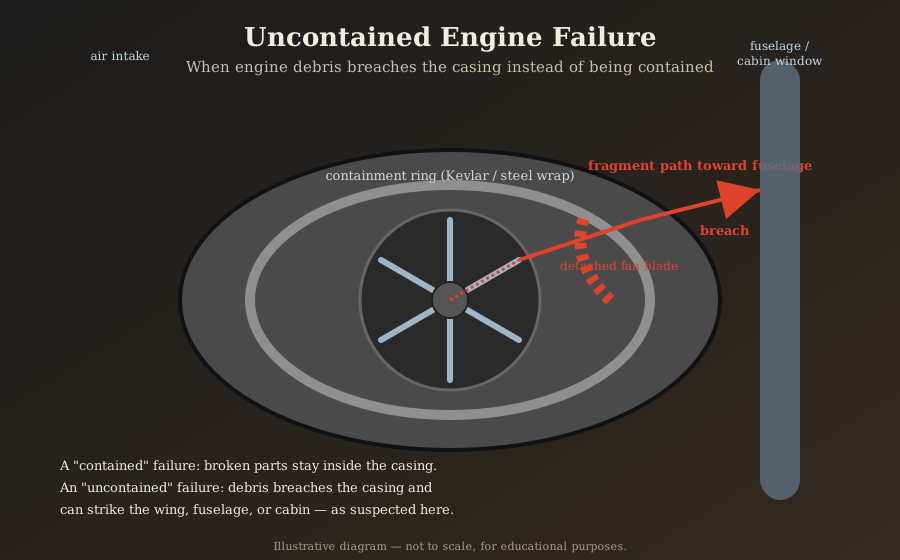
      Diagram of an uncontained engine failure

      Two separate threads will likely dominate the inquiry: why engine debris was able to depart the engine casing and strike the fuselage (a containment failure question, known in the industry as an uncontained engine failure), and why the window assembly failed as it did under that impact. Both feed into broader scrutiny of maintenance and manufacturing oversight that has followed Boeing 737 aircraft in recent years.

      For passengers, the practical takeaway hasn’t changed in decades: keep your seatbelt fastened whenever seated, even when the sign is off. In this incident, it may have made the difference between a terrifying scare and a fatality.


      This article is based on public reporting from CNN, Bloomberg, the Irish Times, and Greek broadcaster ERT, as investigations by Greek and international aviation authorities remain ongoing. Details may be updated as official findings are released.