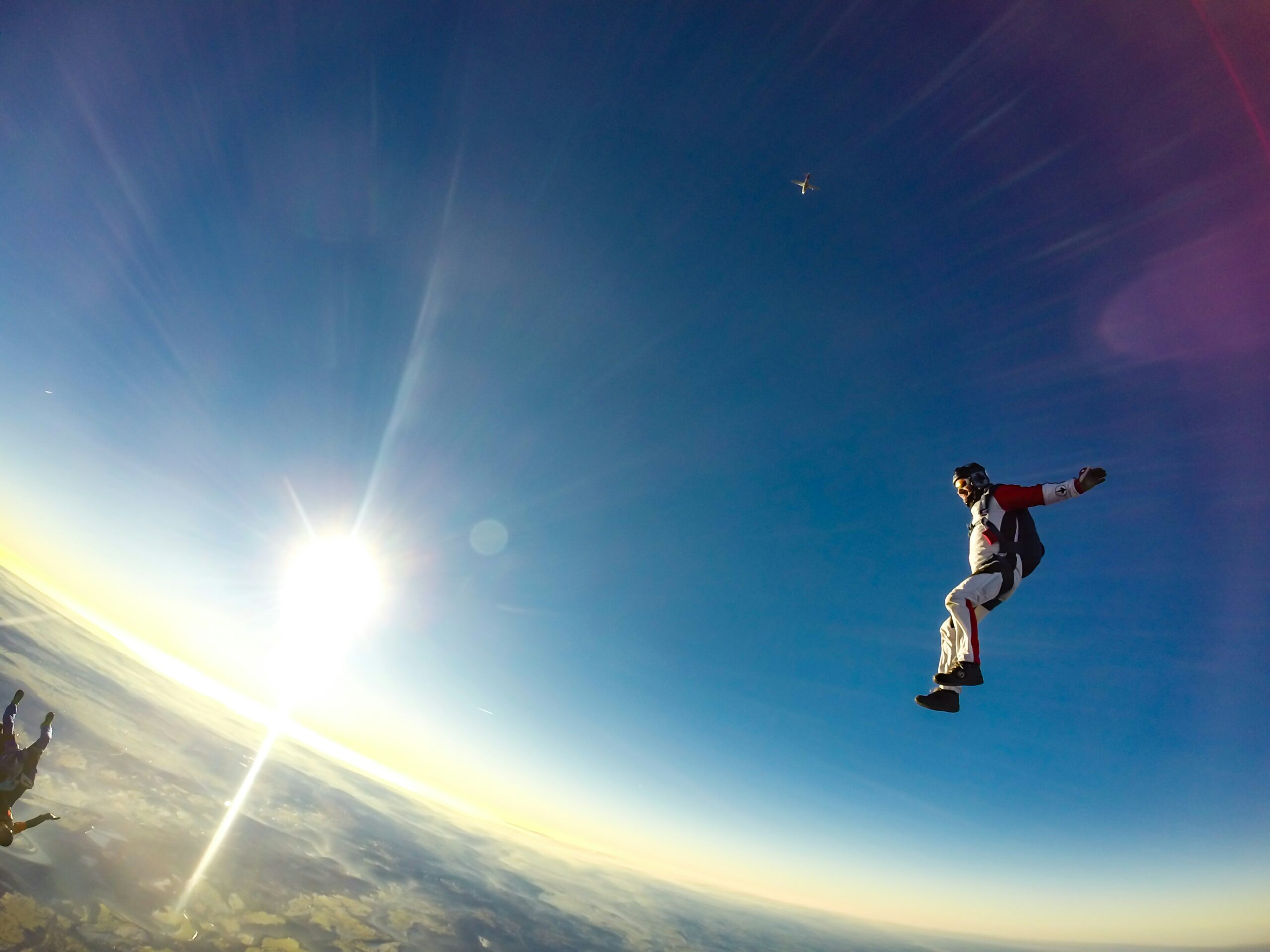
Picture jumping from a plane thousands of meters up, with no parachute. Would your falling speed keep climbing without limit, all the way to impact? Surprisingly, no — and the physics behind that is exactly why skydivers get a real window to deploy their chute.
Free fall is one of physics’ most intuitive — yet most misunderstood — phenomena. When a body leaves an aircraft without a parachute, it immediately begins accelerating under gravity, but that acceleration doesn’t last forever.
Initial Acceleration
In the first moments of the fall, the body accelerates at a constant rate of 9.81 m/s² — the standard value of gravitational acceleration at Earth’s surface. That means:
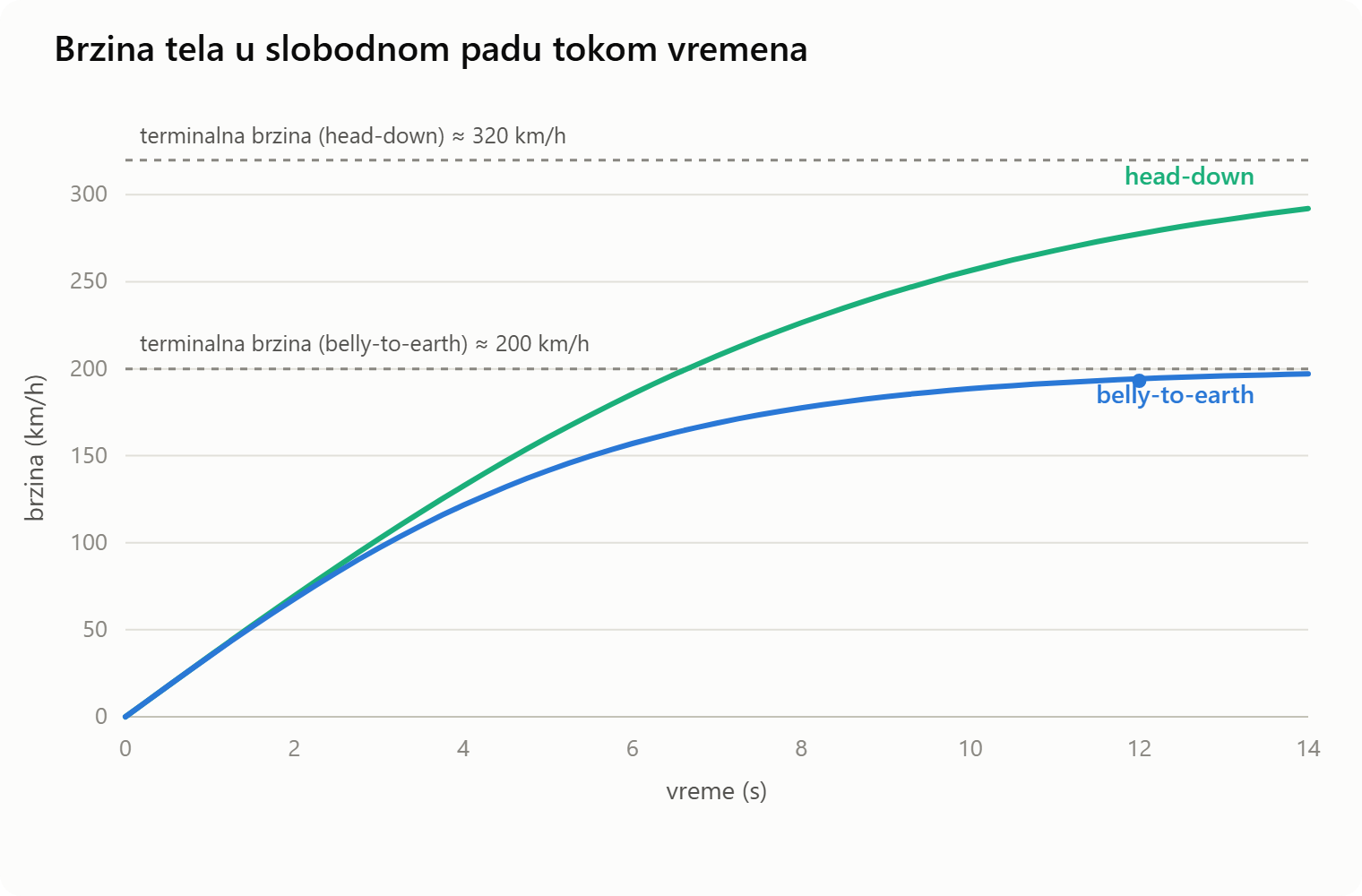
- after 1 second of falling, speed reaches roughly 35 km/h
- after 2 seconds, it’s already around 70 km/h
At this stage, the fall behaves like a textbook physics problem — no interference, just gravity.
Why Acceleration Doesn’t Last Forever
As speed increases, so does air resistance acting against the direction of motion. At a certain point, the force of air resistance equals the force of gravity, and the body stops accelerating. This state is called terminal velocity.
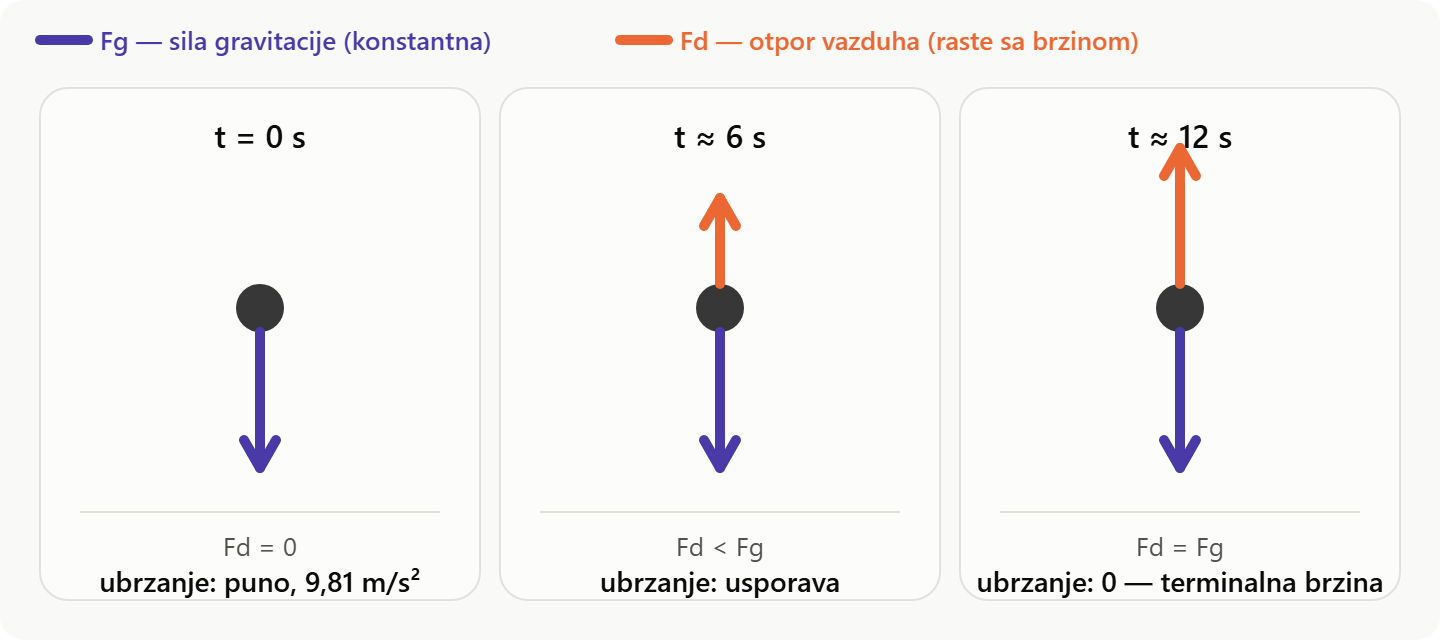
For an average human body in a horizontal position (the “belly-to-earth” pose used by skydivers), terminal velocity is reached:
- after approximately 12 seconds of falling
- around 450 meters of altitude
- at a speed of roughly 200 km/h
The Body Position Factor
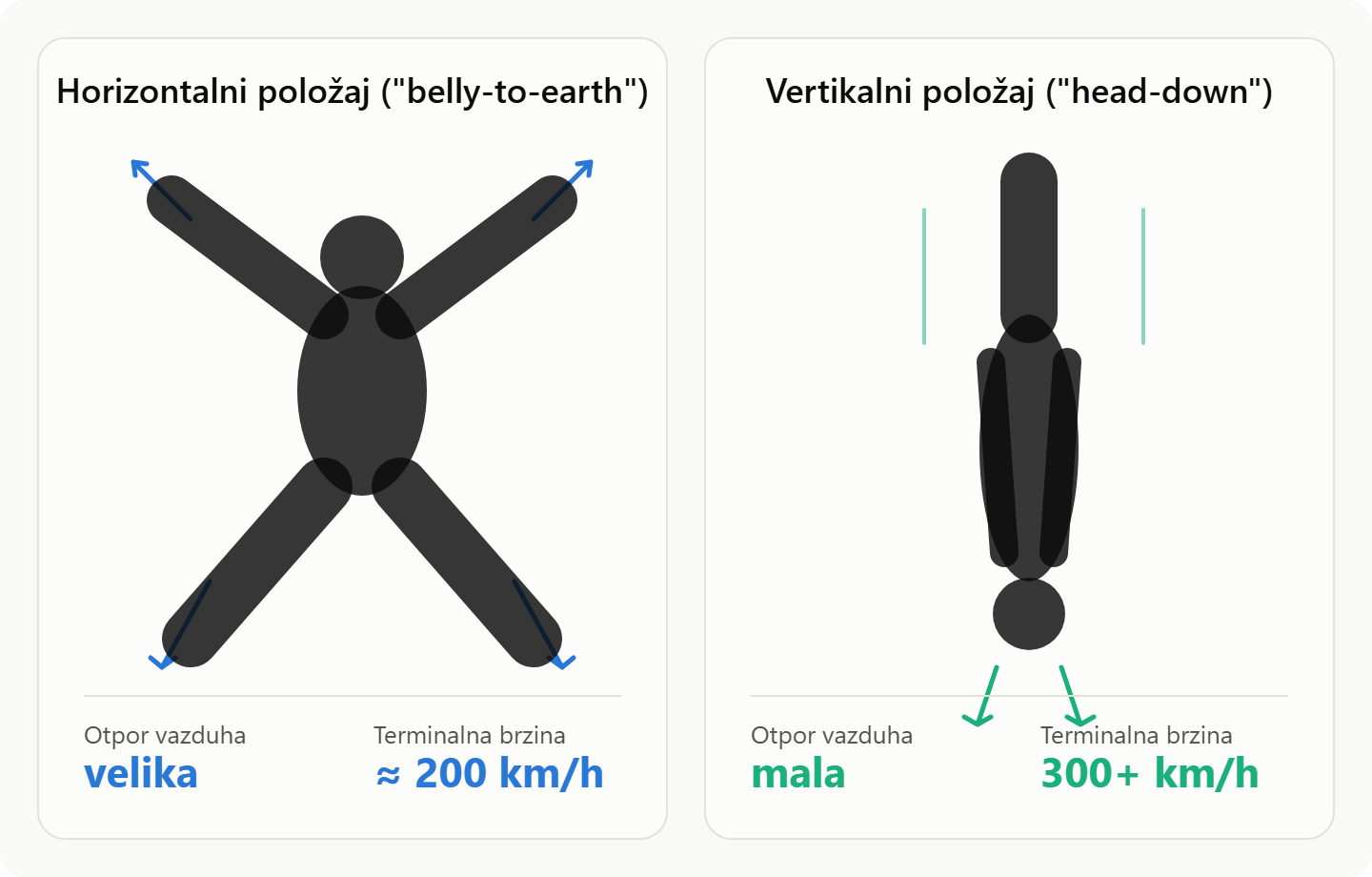
Body orientation significantly affects terminal velocity. If the body orients vertically, head or feet first (“head-down” position), the surface area exposed to air resistance decreases, and terminal velocity can exceed 300 km/h.
Quick facts
- Gravitational acceleration: 9.81 m/s²
- Terminal velocity (horizontal position): ~200 km/h after ~12 s
- Terminal velocity (head-down): 300+ km/h
- Altitude to reach terminal velocity: ~450 m
Conclusion
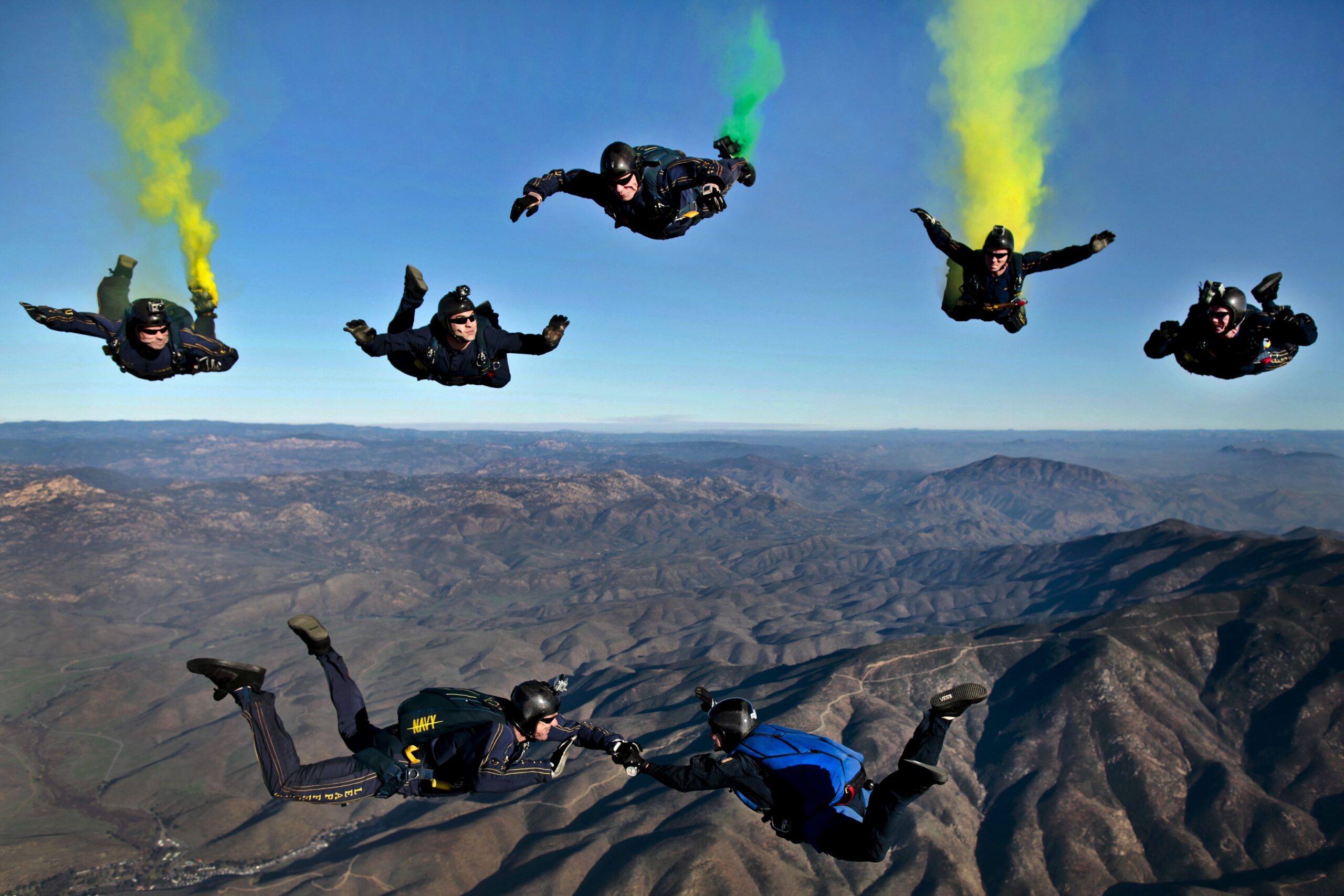
Free fall isn’t a linear acceleration to impact — physics imposes a speed limit well before the body would reach the ground from great height. This is one reason skydivers have time to deploy a parachute even when jumping from several thousand meters.
Frequently Asked Questions
Could someone survive hitting the ground at terminal velocity?
An impact at ~200 km/h is almost always fatal, but there are rare, documented survival cases owing to favorable landing conditions (soft terrain, impact angle, etc.).
Does terminal velocity depend on a person’s weight?
Yes, partly — heavier bodies with similar surface area reach a somewhat higher terminal velocity, since the mass-to-drag ratio is greater.
Leave a Reply