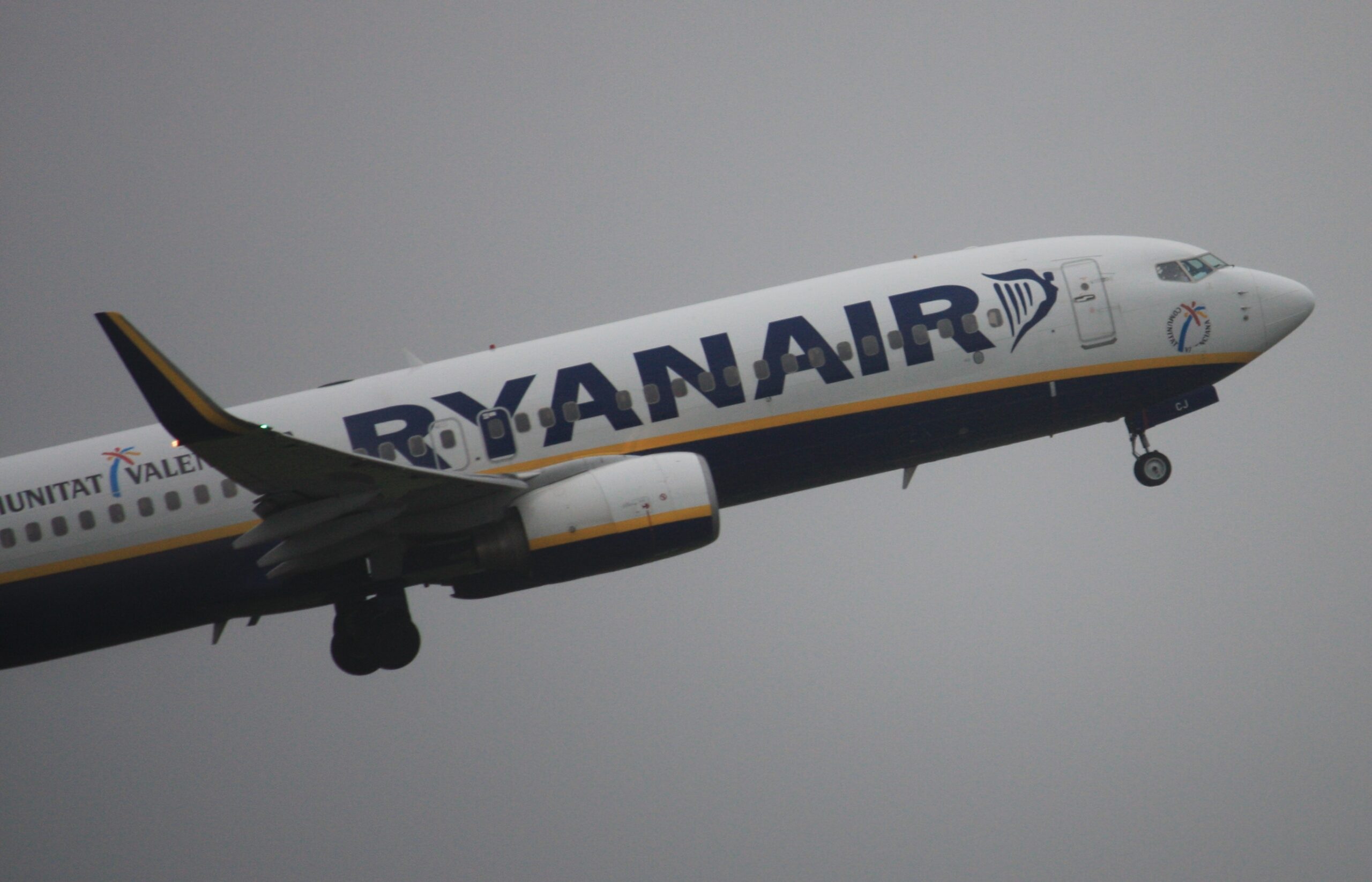
On Friday morning, a routine Ryanair departure from Thessaloniki to Memmingen, Germany, turned into a mid-air emergency that has reignited public fascination with one of aviation’s rarer and more frightening failure modes: sudden loss of cabin pressure.
What happened aboard FR1879
Flight FR1879 departed Thessaloniki at 6:12 a.m. local time on Friday, July 10, 2026. About eight to ten minutes into the climb, as the Boeing 737 operating for Ryanair (registered to sister carrier Malta Air) passed roughly 15,000–16,000 feet, it suffered an apparent engine problem. Debris — reportedly including a fan blade — struck the fuselage and shattered a cabin window. The sudden opening triggered an immediate pressure loss, and the passenger seated beside the window was pulled toward the gap, his head and shoulders briefly outside the aircraft.
Passengers described a bang “like a tire bursting,” followed by screaming as oxygen masks dropped from the ceiling. Crucially, the man’s seatbelt was fastened, and it is widely credited — along with the grip of the person seated next to him — with keeping him from being pulled further out. The crew declared an emergency, flew a rapid descent, and returned the aircraft to Thessaloniki within minutes. One passenger was treated on the ground; everyone else continued their journey on a replacement aircraft.
Greek and Irish aviation authorities, along with the US National Transportation Safety Board, are now investigating both the engine failure and the structural loss of the window.
Explosive decompression: the physics in plain terms
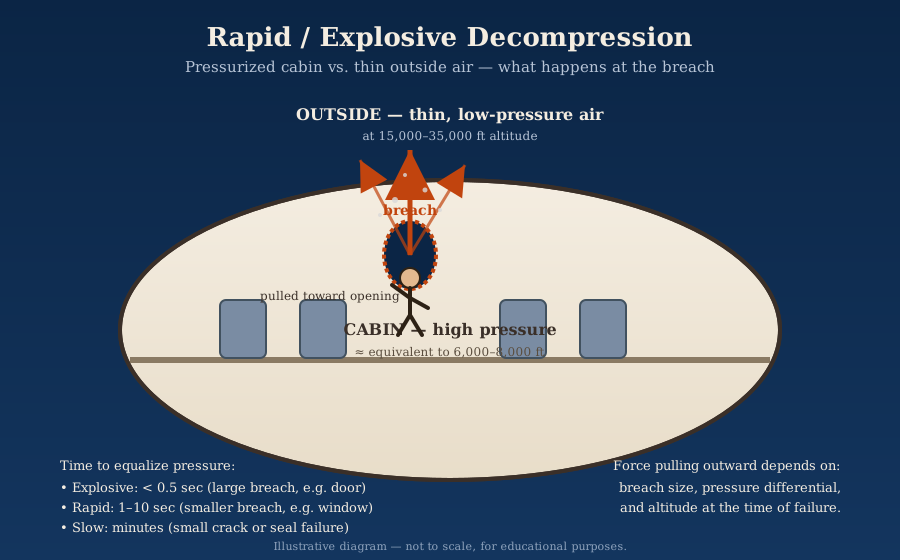
Aviation engineers actually distinguish between several categories of pressure loss, and the distinction matters enormously for what a passenger experiences:
- Explosive decompression happens in under half a second, typically from a large structural failure (a blown door or major fuselage breach). The pressure differential equalizes almost instantly, producing a violent outward rush of air, a fog of condensation, and genuine risk of objects — and unsecured people — being ejected.
- Rapid decompression takes a few seconds, as with a smaller opening like a window. Still forceful, still deafening, but marginally less instantaneous.
- Slow decompression, from a failed seal or small crack, can go unnoticed for minutes without an alarm.
A critical detail in Friday’s incident: it occurred shortly after takeoff, not at cruising altitude. Cabin pressure differential builds progressively as an aircraft climbs toward cruise (typically 35,000–40,000 feet), where the pressure difference between the cabin and outside air is at its maximum. At a few thousand feet, the differential is far smaller — which is almost certainly why the outcome here was survivable without irreversible injury, whereas the same failure at cruise altitude could produce far more severe forces, hypoxia risk, and a shorter window for the crew to act.
Standard operating procedure: what the crew is trained to do
Airline crews drill decompression scenarios regularly, and the sequence is standardized across manufacturers:
- Don oxygen masks immediately — pilots first, since impaired judgment at altitude can happen within seconds without supplemental oxygen.
- Initiate an emergency descent, generally to 10,000 feet or the nearest safe altitude above terrain, as fast as the aircraft safely allows — often exceeding 3,000 feet per minute.
- Declare an emergency (squawk 7700) and coordinate immediately with air traffic control for priority routing and, if needed, diversion.
- Secure the cabin: cabin crew, once masks are confirmed, assess injuries, check for secondary hazards (loose debris, fire risk), and prepare for landing.
- Land at the nearest suitable airport — in this case, a return to the departure airport rather than continuing toward Germany.
By all accounts, the FR1879 crew executed this playbook closely: masks deployed, a fast descent, a return to Thessaloniki within minutes of departure.
How real is the “held onto him” scenario?
This is where physics gets more encouraging than the footage suggests. Full ejection of an adult through a standard passenger window is aerodynamically difficult: airline windows are roughly the size of a dinner plate — far smaller than the width of a person’s shoulders — so the opening itself limits how much of a body can pass through, and the force pulling outward drops off sharply once shoulders wedge against the frame. That’s consistent with reporting here: the passenger went out head-and-shoulders first and no further, aided by his seatbelt.
There is a well-known precedent that makes the “someone held on” detail entirely credible: British Airways Flight 5390 in 1990, when a cockpit windscreen blew out at altitude and the captain was sucked halfway out of the aircraft, torso outside the fuselage, for over twenty minutes. He survived because a flight attendant grabbed his legs and physically held on until the crew could land — a case still taught in aviation safety training today. Compared to that scenario, Friday’s incident involved a smaller opening, lower altitude, and a seatbelt already in place, all of which make a fellow passenger successfully holding on considerably more plausible, not less.
What investigators will be looking for
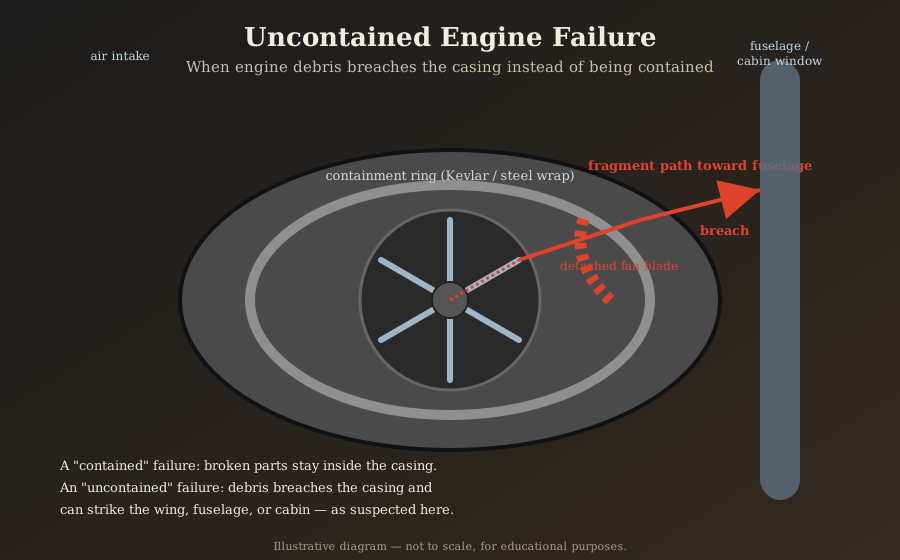
Two separate threads will likely dominate the inquiry: why engine debris was able to depart the engine casing and strike the fuselage (a containment failure question, known in the industry as an uncontained engine failure), and why the window assembly failed as it did under that impact. Both feed into broader scrutiny of maintenance and manufacturing oversight that has followed Boeing 737 aircraft in recent years.
For passengers, the practical takeaway hasn’t changed in decades: keep your seatbelt fastened whenever seated, even when the sign is off. In this incident, it may have made the difference between a terrifying scare and a fatality.
This article is based on public reporting from CNN, Bloomberg, the Irish Times, and Greek broadcaster ERT, as investigations by Greek and international aviation authorities remain ongoing. Details may be updated as official findings are released.