Category: Industry News

  • airBaltic Flight BT1412: A 43-Minute Loop That Never Left Zurich

    airBaltic Flight BT1412: A 43-Minute Loop That Never Left Zurich

    On July 10, 2026, airBaltic flight BT1412 departed Zurich Airport (ZRH) at 8:29 a.m. local time and landed back at the very same airport just 43 minutes later, at 9:12 a.m. Flight-tracking data from FlightAware shows a flight that never actually went anywhere — and the shape of its track tells its own story. The flight also pushed back later than scheduled: FlightAware shows BT1412 leaving gate D57 at 8:11 a.m. — about an hour and twenty minutes behind schedule — and landing at 9:12 a.m., itself roughly an hour and twelve minutes late. The airborne portion of the flight, from takeoff to touchdown, lasted only 43 minutes.
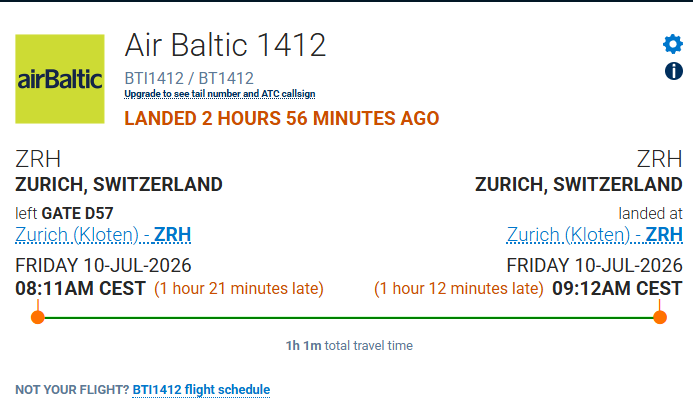
    FlightAware summary for airBaltic flight BT1412, Zurich to Zurich

    What the Data Shows

    FlightAware altitude and speed track for airBaltic flight BT1412

    According to the recorded flight path, BT1412 climbed out of Zurich to the northeast, leveling off at roughly 16,000–17,000 feet — well below a typical airliner cruise altitude — and held that altitude for a stretch of the flight. Ground speed peaked at around 400 mph before easing off. Rather than heading toward any destination, the aircraft flew a wide loop over the area near the Austrian and Liechtenstein border, including one unusually tight circular loop, before turning back and descending into Zurich to land on the same runway system it departed from.

    What This Kind of Flight Usually Means

    A short round-trip flight that reaches a modest altitude, holds it briefly, and includes tight turning patterns is a classic profile for a training or functional check flight rather than a scheduled passenger service — airlines regularly operate these under an active flight number, often for pilot proficiency checks, type-rating training, or a post-maintenance test flight to confirm an aircraft’s systems before it returns to commercial service. It’s worth noting this is an interpretation based on the tracked flight path itself; airBaltic has not issued a public statement about this specific flight, and FlightAware data alone doesn’t state the flight’s purpose.

    A Passenger Account Suggests a Technical Issue

    Since this article was first published, AeroHub received a description of the flight from someone who said they were a passenger on board. According to that account, the crew informed passengers before departure that the aircraft had experienced an engine problem, but that it was safe to fly. Roughly ten minutes after takeoff, the same problem reportedly recurred, prompting the crew to turn back to Zurich. The passenger described visible distress among those on board during the return and said the aircraft shook noticeably in the moments before landing. After touching down, the aircraft was reportedly taken directly for maintenance, with fire crews present on the ground.

    AeroHub has not been able to independently verify this account, and airBaltic has not issued a public statement confirming or denying it. Given this, the flight-path interpretation above — based purely on the shape of the tracked route — should be read alongside this unverified but more concerning description from someone who says they were on board. We will update this article if airBaltic or another verified source provides an official account.

    Why It Matters

    Flights like BT1412 can have several explanations, from routine training and check flights to a genuine in-air return following a technical issue. Flight-tracking data alone — altitude, speed, and the shape of a route — cannot definitively distinguish between the two. Only an official statement from the airline, or confirmation from aviation authorities, can settle which explanation applies here.

    Source: FlightAware flight history

  • Air Canada 737 MAX 8 Veers Off Runway Into Grass After Landing in Montreal

    Air Canada 737 MAX 8 Veers Off Runway Into Grass After Landing in Montreal

    An Air Canada Boeing 737 MAX 8 veered off the taxiway and came to a stop on the grass after landing at Montreal-Trudeau International Airport on Thursday, July 9. No injuries were reported among the 156 passengers and six crew on board.

    What Happened

    Flight AC774, arriving from Los Angeles, landed on runway 06L at 3:57 p.m. — 41 minutes ahead of schedule — in rain and variable winds. According to ADS-B tracking data, the aircraft touched down normally and exited the runway via taxiway B3 at a ground speed of 55 knots, but failed to turn onto taxiway B and instead veered into the grass, where it came to rest.

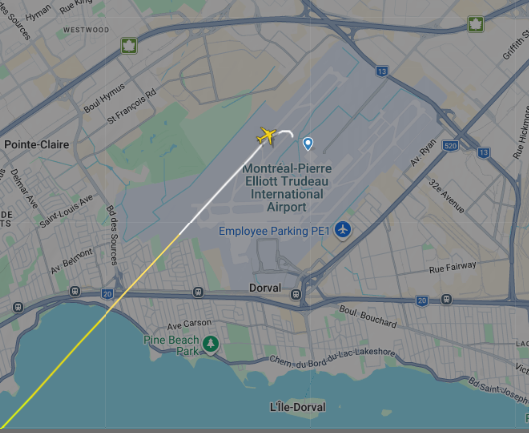
    Flight tracking data showing AC774 on approach to Montreal-Trudeau Airport
    Flight tracking data showing AC774’s approach into Montreal-Trudeau.
    Air Canada Boeing 737 MAX 8 resting on the grass after exiting the runway at Montreal-Trudeau Airport

    Aircraft and Passengers

    The aircraft involved, registered C-GEOJ, was delivered to Air Canada in 2022. By 7:45 p.m., Air Canada confirmed that all passengers and crew had disembarked and been bused to the terminal. The 737 MAX 8 will be towed to a hangar for a full inspection.

    Airport Impact

    The runway was temporarily closed following the incident, causing delays of roughly 30 minutes for domestic and international flights, and 45 minutes to an hour for flights to the United States. The runway reopened just before 10 p.m. the same evening.

    What’s Next

    Air Canada has launched an investigation into the cause of the excursion and says it is working with the relevant authorities as the review continues.

    Sources: CBC News, Simple Flying, FlightGlobal

  • Wizz Air’s Belgrade Base Faces Closure Threat Amid Regulatory Standoff With Serbia

    Wizz Air’s Belgrade Base Faces Closure Threat Amid Regulatory Standoff With Serbia

    Wizz Air’s Belgrade base — in operation since 2010 — is at risk of shutting down from November 2026, after Serbia’s Civil Aviation Directorate (CAD) amended the rules governing how foreign carriers can operate flights to and from the country.

    What Changed

    In March 2026, Serbia’s CAD adopted amendments limiting EU carriers exercising third- and fourth-freedom traffic rights to flights that either originate or terminate within the European Union or their home state. Wizz Air says this effectively rules out operating a base in Belgrade, since a base depends on aircraft flying onward to destinations outside that narrow scope.

    What’s at Stake

    Wizz Air currently bases four aircraft in Belgrade and serves 23 destinations from the Serbian capital. The airline handled close to two million passengers on its Serbia routes in 2025 across roughly 9,600 flights, and had been expanding aggressively — seats on sale for the first half of 2026 were up 32.4% year-on-year, with new routes added to cities including Berlin and Grenoble.

    Wizz Air’s Response

    The airline has publicly condemned the move, stating:

    “We’re the only foreign airline that wanted to invest in the Serbian market, because we believe in connecting the Serbian people to the rest of the world.”

    Wizz Air added that it “remains committed to Serbia, to the nation, to offering great services to local and foreign passengers,” while also stating it “reserves and plans to exercise any and every right it has to reverse this decision” — a signal that legal action remains on the table.

    Where Things Stand

    As of late June 2026, talks between Wizz Air and Serbian authorities have produced no breakthrough. The European Commission has confirmed it is in contact with Serbian authorities to assess whether the new rule is compatible with Serbia’s obligations under the European Common Aviation Area (ECAA) Agreement. A public petition opposing the closure has gathered roughly 5,000 signatures.

    With the November 2026 deadline approaching and no resolution in sight, Belgrade’s aviation market — and Wizz Air’s future in it — remains one of the region’s most closely watched regulatory disputes.

    Sources: Wizz Air Newsroom, EX-YU Aviation News, Aviation Week

  • EASA Releases New Tool to Assess Noise Levels of Light Propeller-Driven Aeroplanes

    EASA Releases New Tool to Assess Noise Levels of Light Propeller-Driven Aeroplanes

    The European Union Aviation Safety Agency (EASA) has released ENCODE — the EASA Noise Compliance Demonstration Evaluator — a new tool designed to calculate noise levels and confidence intervals from noise testing data for light propeller-driven aeroplanes.

    What ENCODE Does

    ENCODE is a Microsoft Excel-based tool that processes data measured during noise tests conducted under Chapter 10 of ICAO Annex 16, Volume I. It validates each individual test run against environmental and performance limitations, then standardizes how the resulting noise levels are determined and reported.

    Why EASA Built It

    According to EASA, the tool is meant to:

    • Harmonize noise reporting for light propeller-driven aeroplanes, as required under EASA’s Environmental Requirements
    • Reduce the workload for applicants and noise experts carrying out compliance demonstrations
    • Ensure a consistent methodology is applied across noise assessments industry-wide

    Where to Find It

    ENCODE and its accompanying User Guide are available on EASA’s website, under the “Light propeller-driven aeroplanes” section of the Environment domain (Technology / Aircraft Noise and Emissions Data).

    The release is part of EASA’s broader environmental protection framework for general aviation, aimed at making noise compliance demonstrations more consistent and less burdensome for manufacturers and testing organizations alike.

    Source: EASA Newsroom

  • Identify. Verify. Repeat: How Aviation Turns Information Into Accuracy

    Identify. Verify. Repeat: How Aviation Turns Information Into Accuracy

    In aviation, accuracy is never the starting point. It’s the result. A pilot isn’t accurate because of talent or experience — they’re accurate because, at every moment, they have access to verified, complete, and timely information. Remove the information, and accuracy disappears with it: without being informed, there is no accuracy — and without accuracy, there is no safety.

    The Core Discipline: Identify, Verify

    Aviation troubleshooting runs on a two-step sequence, drilled until it becomes reflex: identify the anomaly, then verify it through an independent source before acting on it. Skipping either step is where accidents begin.

    • Identify — notice that something doesn’t match the expected state (a light, a reading, a sound)
    • Verify — confirm it through a second, independent method before treating it as fact

    Applied consistently, across every parameter — not just the one demanding attention — this habit is what separates an accurate decision from a lucky one.

    When the Habit Broke: Eastern Air Lines Flight 401

    On December 29, 1972, an Eastern Air Lines Lockheed L-1011 was on approach to Miami International Airport with 176 people aboard. A burnt-out indicator bulb — meant to confirm the nose landing gear was down — caught the crew’s attention.

    • The crew identified the anomaly correctly and even verified it: sending someone to check the gear visually, cycling the indicator
    • But they never applied the same discipline to the aircraft itself
    • Someone inadvertently disconnected the autopilot; the aircraft began a slow, unnoticed descent
    • No one independently verified altitude — the one parameter that mattered most

    The aircraft descended into the Everglades. 101 people died. No system failed. The gear was down. The crew verified the wrong thing thoroughly, and the right thing not at all.

    This accident became the foundation for Crew Resource Management (CRM): an accurate decision is only possible when the information behind it is identified, verified, and shared with everyone who needs it.

    The Same Equation Outside the Cockpit

    • A surgeon whose accurate judgment depends on identifying and verifying vital signs across multiple monitors, not one
    • An analyst whose accurate forecast depends on verifying broader market context, not a single metric
    • A manager whose accurate decision depends on whether they verified the data, or simply assumed it

    Why This Site Exists

    AeroHub exists to secure that connection — from information to accuracy:

    • Clear, verified news — not sensationalism
    • Structured education — not shortcuts
    • Real footage and analysis — not noise
    • A community that shares information instead of hoarding it

    Fly Informed, Decide Accurately

    Explore News for verified reporting on what’s shaping aviation, deepen your knowledge in Education, or join the Forum and share what you know with people for whom accuracy is a daily job.

    Identify. Verify. The sky doesn’t forgive skipping either one. Neither does life outside it.

  • Airline Alliance Expands Codeshare Network

    Airline Alliance Expands Codeshare Network

    A major airline alliance has announced an expanded codeshare agreement, adding dozens of new connecting itineraries for travelers. The move strengthens the alliance’s footprint in emerging markets.