
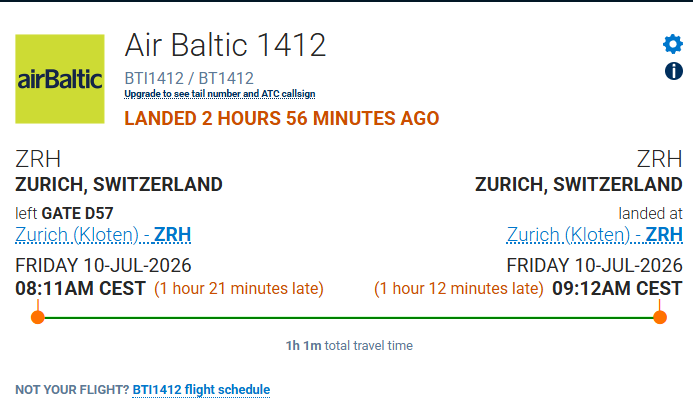
On July 10, 2026, airBaltic flight BT1412 departed Zurich Airport (ZRH) at 8:29 a.m. local time and landed back at the very same airport just 43 minutes later, at 9:12 a.m. Flight-tracking data from FlightAware shows a flight that never actually went anywhere — and the shape of its track tells its own story. The flight also pushed back later than scheduled: FlightAware shows BT1412 leaving gate D57 at 8:11 a.m. — about an hour and twenty minutes behind schedule — and landing at 9:12 a.m., itself roughly an hour and twelve minutes late. The airborne portion of the flight, from takeoff to touchdown, lasted only 43 minutes.
What the Data Shows

According to the recorded flight path, BT1412 climbed out of Zurich to the northeast, leveling off at roughly 16,000–17,000 feet — well below a typical airliner cruise altitude — and held that altitude for a stretch of the flight. Ground speed peaked at around 400 mph before easing off. Rather than heading toward any destination, the aircraft flew a wide loop over the area near the Austrian and Liechtenstein border, including one unusually tight circular loop, before turning back and descending into Zurich to land on the same runway system it departed from.
What This Kind of Flight Usually Means
A short round-trip flight that reaches a modest altitude, holds it briefly, and includes tight turning patterns is a classic profile for a training or functional check flight rather than a scheduled passenger service — airlines regularly operate these under an active flight number, often for pilot proficiency checks, type-rating training, or a post-maintenance test flight to confirm an aircraft’s systems before it returns to commercial service. It’s worth noting this is an interpretation based on the tracked flight path itself; airBaltic has not issued a public statement about this specific flight, and FlightAware data alone doesn’t state the flight’s purpose.
A Passenger Account Suggests a Technical Issue
Since this article was first published, AeroHub received a description of the flight from someone who said they were a passenger on board. According to that account, the crew informed passengers before departure that the aircraft had experienced an engine problem, but that it was safe to fly. Roughly ten minutes after takeoff, the same problem reportedly recurred, prompting the crew to turn back to Zurich. The passenger described visible distress among those on board during the return and said the aircraft shook noticeably in the moments before landing. After touching down, the aircraft was reportedly taken directly for maintenance, with fire crews present on the ground.
AeroHub has not been able to independently verify this account, and airBaltic has not issued a public statement confirming or denying it. Given this, the flight-path interpretation above — based purely on the shape of the tracked route — should be read alongside this unverified but more concerning description from someone who says they were on board. We will update this article if airBaltic or another verified source provides an official account.
Why It Matters
Flights like BT1412 can have several explanations, from routine training and check flights to a genuine in-air return following a technical issue. Flight-tracking data alone — altitude, speed, and the shape of a route — cannot definitively distinguish between the two. Only an official statement from the airline, or confirmation from aviation authorities, can settle which explanation applies here.
Source: FlightAware flight history