Author: admin

  • Air Canada 737 MAX 8 Veers Off Runway Into Grass After Landing in Montreal

    Air Canada 737 MAX 8 Veers Off Runway Into Grass After Landing in Montreal

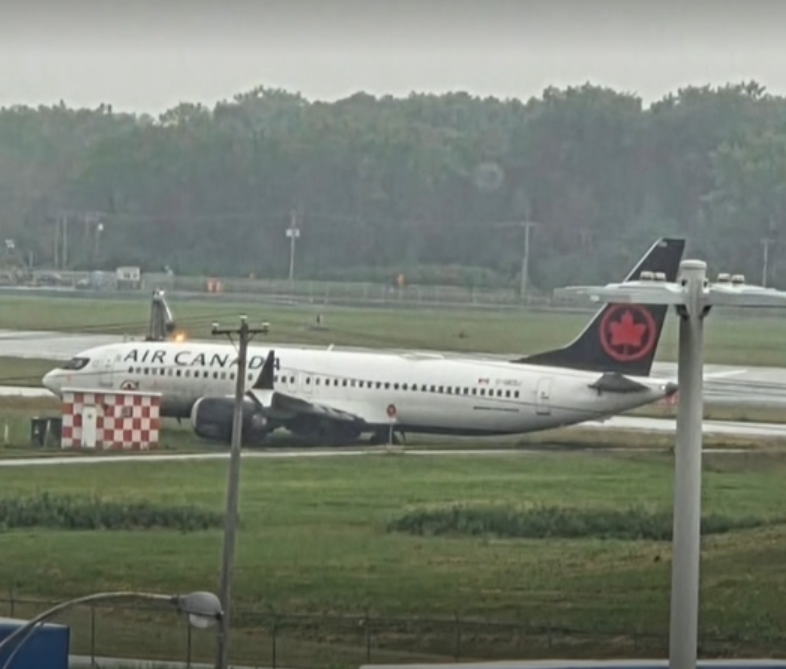
    An Air Canada Boeing 737 MAX 8 veered off the taxiway and came to a stop on the grass after landing at Montreal-Trudeau International Airport on Thursday, July 9. No injuries were reported among the 156 passengers and six crew on board.

    What Happened

    Flight AC774, arriving from Los Angeles, landed on runway 06L at 3:57 p.m. — 41 minutes ahead of schedule — in rain and variable winds. According to ADS-B tracking data, the aircraft touched down normally and exited the runway via taxiway B3 at a ground speed of 55 knots, but failed to turn onto taxiway B and instead veered into the grass, where it came to rest.
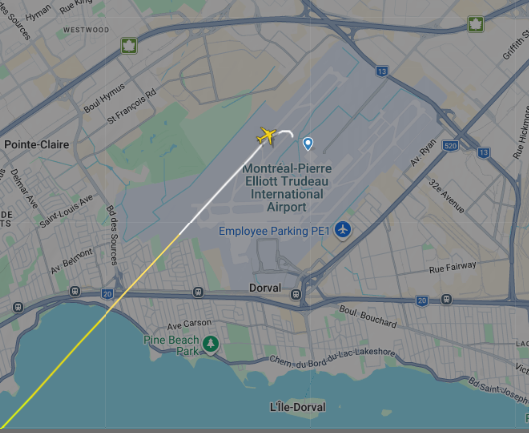
    Flight tracking data showing AC774 on approach to Montreal-Trudeau Airport
    Flight tracking data showing AC774’s approach into Montreal-Trudeau.
    Air Canada Boeing 737 MAX 8 resting on the grass after exiting the runway at Montreal-Trudeau Airport

    Aircraft and Passengers

    The aircraft involved, registered C-GEOJ, was delivered to Air Canada in 2022. By 7:45 p.m., Air Canada confirmed that all passengers and crew had disembarked and been bused to the terminal. The 737 MAX 8 will be towed to a hangar for a full inspection.

    Airport Impact

    The runway was temporarily closed following the incident, causing delays of roughly 30 minutes for domestic and international flights, and 45 minutes to an hour for flights to the United States. The runway reopened just before 10 p.m. the same evening.

    What’s Next

    Air Canada has launched an investigation into the cause of the excursion and says it is working with the relevant authorities as the review continues.

    Sources: CBC News, Simple Flying, FlightGlobal

  • How I Became a Pilot

    How I Became a Pilot

    I’ve been close to what happens in transport and logistics my whole life, even though I didn’t recognize it as a sign at the time. My father was a basketball player, and later an international referee and delegate, which meant he was constantly traveling. As a small child, I would wait for him to come home — usually by plane. That feeling of anticipation, the sound of an aircraft landing, quietly built something in me long before I understood what it was.

    nn

    My First Flight: A DC-9 and Landing in Dubrovnik

    Then, one day, my father took me on my first-ever flight — a DC-9. The experience was indescribable. The DC-9 has always held a special appeal for passengers because of its rear-mounted engines — they make the cabin unexpectedly quiet for an aircraft of its era, while the real power only becomes apparent at the moment of takeoff, when the aircraft climbs sharply and steeply, leaving that unforgettable pit-in-the-stomach feeling every future pilot remembers well. Landing in Dubrovnik, with the sea and the old city walls in view, stayed etched in my memory as the moment aviation stopped being something I watched from the outside and became something I wanted to live.

    Years of Travel

    After that, I started traveling a lot myself — first for university overseas, and later for work, across Europe. I kept thinking about how to shorten travel time, and often dreamed about one day, as a pilot, flying straight to my hometown — Novi Sad.

    The Ad That Started It All

    Years later, the financial conditions finally lined up — aviation is, let’s be honest, an expensive path — and I finally found the time as well. That’s exactly when I stumbled onto an ad for a flight school offering a discount. From that moment on, my path to the cockpit was set.

    Training Across Three Countries

    I completed my PPL training in Serbia, then enrolled in ATPL theory in Hungary, before finally passing my CPL in Croatia. I consider this path — across three different countries and schools — to have been extremely valuable. I saw different ways of doing things, and met and flew with many people and instructors who gave me experience I couldn’t put a price on. I believe I learned far more this way than I would have by staying at a single school from start to finish, in the classic “zero to hero” model.

    Today — and What Comes Next

    Today I’m a commercial pilot, with full privileges and ratings on single-engine and multi-engine aircraft, as well as an instrument rating (IR). Do you think this is the end of the road? No — this is only the end of the beginning. The best is yet to come.

  • Wizz Air’s Belgrade Base Faces Closure Threat Amid Regulatory Standoff With Serbia

    Wizz Air’s Belgrade Base Faces Closure Threat Amid Regulatory Standoff With Serbia

    Wizz Air’s Belgrade base — in operation since 2010 — is at risk of shutting down from November 2026, after Serbia’s Civil Aviation Directorate (CAD) amended the rules governing how foreign carriers can operate flights to and from the country.

    What Changed

    In March 2026, Serbia’s CAD adopted amendments limiting EU carriers exercising third- and fourth-freedom traffic rights to flights that either originate or terminate within the European Union or their home state. Wizz Air says this effectively rules out operating a base in Belgrade, since a base depends on aircraft flying onward to destinations outside that narrow scope.

    What’s at Stake

    Wizz Air currently bases four aircraft in Belgrade and serves 23 destinations from the Serbian capital. The airline handled close to two million passengers on its Serbia routes in 2025 across roughly 9,600 flights, and had been expanding aggressively — seats on sale for the first half of 2026 were up 32.4% year-on-year, with new routes added to cities including Berlin and Grenoble.

    Wizz Air’s Response

    The airline has publicly condemned the move, stating:

    “We’re the only foreign airline that wanted to invest in the Serbian market, because we believe in connecting the Serbian people to the rest of the world.”

    Wizz Air added that it “remains committed to Serbia, to the nation, to offering great services to local and foreign passengers,” while also stating it “reserves and plans to exercise any and every right it has to reverse this decision” — a signal that legal action remains on the table.

    Where Things Stand

    As of late June 2026, talks between Wizz Air and Serbian authorities have produced no breakthrough. The European Commission has confirmed it is in contact with Serbian authorities to assess whether the new rule is compatible with Serbia’s obligations under the European Common Aviation Area (ECAA) Agreement. A public petition opposing the closure has gathered roughly 5,000 signatures.

    With the November 2026 deadline approaching and no resolution in sight, Belgrade’s aviation market — and Wizz Air’s future in it — remains one of the region’s most closely watched regulatory disputes.

    Sources: Wizz Air Newsroom, EX-YU Aviation News, Aviation Week

  • EASA Releases New Tool to Assess Noise Levels of Light Propeller-Driven Aeroplanes

    EASA Releases New Tool to Assess Noise Levels of Light Propeller-Driven Aeroplanes

    The European Union Aviation Safety Agency (EASA) has released ENCODE — the EASA Noise Compliance Demonstration Evaluator — a new tool designed to calculate noise levels and confidence intervals from noise testing data for light propeller-driven aeroplanes.

    What ENCODE Does

    ENCODE is a Microsoft Excel-based tool that processes data measured during noise tests conducted under Chapter 10 of ICAO Annex 16, Volume I. It validates each individual test run against environmental and performance limitations, then standardizes how the resulting noise levels are determined and reported.

    Why EASA Built It

    According to EASA, the tool is meant to:

    • Harmonize noise reporting for light propeller-driven aeroplanes, as required under EASA’s Environmental Requirements
    • Reduce the workload for applicants and noise experts carrying out compliance demonstrations
    • Ensure a consistent methodology is applied across noise assessments industry-wide

    Where to Find It

    ENCODE and its accompanying User Guide are available on EASA’s website, under the “Light propeller-driven aeroplanes” section of the Environment domain (Technology / Aircraft Noise and Emissions Data).

    The release is part of EASA’s broader environmental protection framework for general aviation, aimed at making noise compliance demonstrations more consistent and less burdensome for manufacturers and testing organizations alike.

    Source: EASA Newsroom

  • Identify. Verify. Repeat: How Aviation Turns Information Into Accuracy

    Identify. Verify. Repeat: How Aviation Turns Information Into Accuracy

    In aviation, accuracy is never the starting point. It’s the result. A pilot isn’t accurate because of talent or experience — they’re accurate because, at every moment, they have access to verified, complete, and timely information. Remove the information, and accuracy disappears with it: without being informed, there is no accuracy — and without accuracy, there is no safety.

    The Core Discipline: Identify, Verify

    Aviation troubleshooting runs on a two-step sequence, drilled until it becomes reflex: identify the anomaly, then verify it through an independent source before acting on it. Skipping either step is where accidents begin.

    • Identify — notice that something doesn’t match the expected state (a light, a reading, a sound)
    • Verify — confirm it through a second, independent method before treating it as fact

    Applied consistently, across every parameter — not just the one demanding attention — this habit is what separates an accurate decision from a lucky one.

    When the Habit Broke: Eastern Air Lines Flight 401

    On December 29, 1972, an Eastern Air Lines Lockheed L-1011 was on approach to Miami International Airport with 176 people aboard. A burnt-out indicator bulb — meant to confirm the nose landing gear was down — caught the crew’s attention.

    • The crew identified the anomaly correctly and even verified it: sending someone to check the gear visually, cycling the indicator
    • But they never applied the same discipline to the aircraft itself
    • Someone inadvertently disconnected the autopilot; the aircraft began a slow, unnoticed descent
    • No one independently verified altitude — the one parameter that mattered most

    The aircraft descended into the Everglades. 101 people died. No system failed. The gear was down. The crew verified the wrong thing thoroughly, and the right thing not at all.

    This accident became the foundation for Crew Resource Management (CRM): an accurate decision is only possible when the information behind it is identified, verified, and shared with everyone who needs it.

    The Same Equation Outside the Cockpit

    • A surgeon whose accurate judgment depends on identifying and verifying vital signs across multiple monitors, not one
    • An analyst whose accurate forecast depends on verifying broader market context, not a single metric
    • A manager whose accurate decision depends on whether they verified the data, or simply assumed it

    Why This Site Exists

    AeroHub exists to secure that connection — from information to accuracy:

    • Clear, verified news — not sensationalism
    • Structured education — not shortcuts
    • Real footage and analysis — not noise
    • A community that shares information instead of hoarding it

    Fly Informed, Decide Accurately

    Explore News for verified reporting on what’s shaping aviation, deepen your knowledge in Education, or join the Forum and share what you know with people for whom accuracy is a daily job.

    Identify. Verify. The sky doesn’t forgive skipping either one. Neither does life outside it.

  • New Long-Haul Routes Announced for 2027

    New Long-Haul Routes Announced for 2027

    Several major carriers have unveiled ambitious plans to expand long-haul networks, adding new nonstop routes connecting secondary hubs across three continents. Industry analysts say the expansion reflects renewed demand for premium long-distance travel and improved aircraft fuel efficiency.

    The new routes are expected to launch in phases throughout next year, with several airlines already opening ticket sales.

  • Next-Generation Avionics Enter Service

    Next-Generation Avionics Enter Service

    A new generation of cockpit avionics is being rolled out across several aircraft families, promising enhanced situational awareness and reduced pilot workload. The systems integrate synthetic vision, predictive weather overlays, and simplified checklist automation.

    Early feedback from flight crews has been largely positive, citing smoother transitions between flight phases.

  • Regulators Update Fatigue Management Rules

    Regulators Update Fatigue Management Rules

    Aviation safety regulators in several regions have proposed updates to flight and duty time regulations, aiming to better account for circadian rhythm science in scheduling long-haul and red-eye operations.

    Industry groups have generally welcomed the proposals while requesting a longer transition period for implementation.

  • Airline Alliance Expands Codeshare Network

    Airline Alliance Expands Codeshare Network

    A major airline alliance has announced an expanded codeshare agreement, adding dozens of new connecting itineraries for travelers. The move strengthens the alliance’s footprint in emerging markets.